15 Classroom Management Tips for New Teachers + Printable Posters
The toughest part of being a new teacher , in my opinion , is not teaching. It is actually managing a class of 30 - 40 students at once of varying motivation.
Having taught for over 10 years now at my piano studio. I have managed my fair share of students and found that there are some universal useful classroom management tips that even primary (elementary) or secondary (High-school) teachers can use.
Here are 15 classroom management tips that a beginning teacher may find helpful.
Also, I will provide a link to my shop where you can purchase the PDF of these 15 tips in a concise manner. It will also come with 23 classroom management posters which you can share with your school or fellow teachers to print and place in your class as a visual aid for your students.
15 Classroom Management Tips for New Teachers
1. Teach expectations explicitly
Students may understand words such as “respectful”, “responsible” or “ready” differently. Instead of merely stating a rule, show students exactly what the expected behaviour looks and sounds like.
Use case: Beginning a lesson
Instead of saying:
“Everyone, be ready to learn.”
Explain:
“Being ready means your book is open, your pencil is on the table, your bag is under your chair and you are completing the warm-up silently.”
Demonstrate it, let students practise it, and correct any misunderstandings.
Another example: Group discussion
“Respectful discussion” could mean:
looking towards the speaker;
allowing the person to finish;
disagreeing with the idea rather than insulting the person;
using an appropriate voice level.
When this is especially useful
Use it at the beginning of the school year, when introducing a new activity, after a long holiday or whenever students repeatedly fail to meet an expectation.
The important principle is: do not assume students already know what you mean.
2. Build predictable routines
A routine is a sequence students can follow without requiring repeated instructions from the teacher.
Routines reduce uncertainty and save teaching time. When students know what happens next, they are less likely to wander around, call out or wait passively.
Use case: Entering the classroom
A simple entry routine might be:
Greet the teacher.
Walk to your assigned seat.
Place your homework in the tray.
Take out the required materials.
Begin the task on the board.
After enough practice, students should be able to complete these steps without the teacher repeatedly reminding them.
Other routines worth teaching
collecting and returning materials;
asking for help;
going to the toilet;
sharpening pencils;
moving into groups;
submitting work;
packing up;
leaving the classroom.
Example: Asking for help
Instead of having ten students calling your name, create a routine:
“First, reread the instructions. Second, ask your partner. Third, place your help card on the corner of your desk.”
When this is especially useful
Routines are particularly valuable in large classes, with younger students, during relief teaching and in classrooms where transitions frequently become noisy.
3. Greet students at the door
Greeting students at the door is more than simply saying hello. It allows you to establish connection, assess students’ emotional states and direct them towards the first task before they enter.
Use case: A student arrives upset
You notice that Ethan is unusually quiet.
Instead of waiting until he becomes disruptive, you might quietly say:
“You seem a little unsettled today. Start with the warm-up, and I will check in with you in a few minutes.”
This acknowledges the student without having a long conversation in front of others.
Use case: A highly energetic class
As each student enters, say:
“Good afternoon. Books out and start Question 1 on the board.”
This creates a calm transition from the corridor into the classroom.
Use case: Reconnecting after conflict
If a student had a difficult lesson yesterday, greeting them normally communicates:
“Today is a fresh start. You still belong here.”
When this is especially useful
Use it when students arrive from recess, lunch, assembly or another lesson where they may be excited, tired or emotionally unsettled.
4. Pre-correct before hotspots
A pre-correction is a short reminder given before a predictable problem occurs.
Instead of waiting for students to misbehave and then reacting, remind them what successful behaviour looks like immediately before the difficult moment.
Use case: Moving into groups
Before students move, say:
“When I say ‘go’, take only your worksheet and pencil. Walk to your group, sit in your assigned place and begin with a level-one voice.”
This is more effective than shouting instructions after students have already started moving.
Use case: Using science equipment
Before distributing equipment:
“The equipment stays on the table until I finish the demonstration. When I say ‘begin’, one person from each group may touch it.”
Use case: Returning from recess
Before students enter:
“We are coming in quietly. Bags go under chairs, bottles go on the table and the warm-up begins immediately.”
Common classroom hotspots
transitions;
group work;
lining up;
practical activities;
computer use;
dismissal;
changing activities;
distributing attractive materials.
A pre-correction should be short. It is not another lecture.
5. Keep students actively engaged
Students are more likely to become distracted when they are waiting, listening passively for too long or completing work that is much too easy or difficult.
Active engagement means giving every student frequent opportunities to think, respond, discuss, write or demonstrate understanding.
Use case: Avoid relying on one volunteer
Instead of asking:
“Who knows the answer?”
Try:
“Everyone write your answer first. Now compare it with your partner. I will ask three people to explain their thinking.”
This prevents the same confident students from answering every question while everyone else switches off.
Use case: Checking understanding quickly
Ask students to:
hold up response cards;
show one to five fingers;
write on mini whiteboards;
complete an exit ticket;
give a choral response;
turn and explain to a partner.
Use case: Attention is beginning to dip
After ten minutes of explanation, pause and say:
“You have thirty seconds to tell your partner the two most important ideas so far.”
Important distinction
Engagement does not mean making every lesson entertaining. It means ensuring students are mentally participating rather than merely sitting quietly.
6. Actively supervise
Active supervision means moving around, scanning the classroom and interacting with students instead of teaching or monitoring from one fixed position.
The goal is not to hover over students. It is to notice problems early and offer support before they escalate.
Use case: Independent writing
Rather than sitting at your desk marking work:
move around the room;
check students’ first sentences;
acknowledge those who have started;
quietly redirect anyone who is distracted;
look for students who misunderstood the task.
You might say quietly:
“You have the heading completed. Now show me how you will begin your first sentence.”
Use case: Group work
Move between groups using different paths. Avoid visiting groups in exactly the same order every time because students may learn when you are unlikely to be nearby.
Use case: Preventing off-task behaviour
You notice two students beginning to whisper and play with stationery. Walking closer may be enough to help them return to work without interrupting the lesson.
Effective supervision should feel like support, not surveillance.
7. Praise the behaviour you want
Effective praise tells students exactly what they did successfully and why it mattered.
General praise such as “Good job” may feel positive, but it does not always tell students what behaviour to repeat.
Use case: Starting work promptly
Instead of:
“Well done, class.”
Say:
“Most of you opened your books and began the warm-up within one minute. That helped us start the lesson on time.”
Use case: A student usually calls out
When the student raises their hand:
“Daniel, you waited until I called your name before speaking. That allowed everyone to hear the instructions.”
Use case: Group collaboration
“I noticed Maya asked for everyone’s opinion before the group decided. That helped the group work fairly.”
Avoid praising fixed traits
Instead of:
“You are so clever.”
Try:
“You checked your calculation and corrected the mistake independently.”
This directs attention towards actions and strategies rather than suggesting success depends on being naturally clever.
Praise should remain sincere. Constant exaggerated praise can feel artificial.
8. Offer structured choices
Structured choices allow students to experience some control while the teacher maintains the learning goal and boundaries.
The choices should all be acceptable to you.
Use case: A student refuses to begin writing
Say:
“You can begin with Question 1 or Question 3. Which one would you like to start with?”
The choice is about where to begin, not whether the student completes the work.
Use case: Choosing a workspace
“You may complete the task at your desk or at the quiet table. Which place will help you concentrate?”
Use case: Demonstrating learning
“You may explain the concept in a paragraph, a labelled diagram or a short recorded explanation.”
Use case: A student is becoming argumentative
Instead of entering a power struggle:
“You may put the phone in your bag or place it on my desk until the end of the lesson.”
Avoid offering false choices such as:
“Would you like to stop talking?”
That is not genuinely a choice if “no” is unacceptable.
9. Use calm, brief corrections
When correcting behaviour, use as few words as necessary. State what is happening, remind the student of the expectation and give them an opportunity to reset.
Long public lectures often embarrass students, interrupt learning and invite arguments.
Use case: Students talking during instructions
“The conversation is continuing. Voices off while instructions are given. Thank you.”
Then continue teaching.
Use case: A student is out of their seat
Quietly say:
“You are away from your workspace. Return to your seat and continue Question 4.”
Use case: A student begins arguing
Instead of debating in front of the class:
“I will speak with you after the instructions. For now, open your book to page 24.”
A useful correction sequence
Describe the behaviour neutrally.
State the expected behaviour.
Allow time to respond.
Acknowledge the reset.
Continue teaching.
For example:
“Your book is closed. Open to page 15 and begin the first question. Thank you for getting started.”
10. Use proximity and quiet cues
Not every minor behaviour requires a verbal correction. Start with the least intrusive prompt likely to work.
This protects the student’s dignity and keeps the lesson moving.
Use case: Quiet talking
While continuing to teach, move closer to the students who are talking. Their conversation may stop without you saying anything.
Use case: Student is on the wrong page
Point towards the page number displayed on the board or quietly tap the written instructions on the student’s desk.
Use case: A student frequently loses focus
Agree on a private signal in advance:
a tap on the desk;
pointing towards the task;
touching your own ear to signal “listen”;
showing a card that means “check the instructions”.
Use case: Whole-class attention
Raise your hand, pause and wait for students to mirror the signal rather than trying to speak over the noise.
The student must be taught what the signal means. A mysterious look or gesture may simply confuse them.
11. Teach replacement behaviours
Telling students what not to do is incomplete. Students also need to know what they should do instead.
A replacement behaviour must serve a similar purpose to the original behaviour.
Use case: Calling out
Do not only say:
“Stop calling out.”
Teach alternatives:
raise a hand;
write the question on a sticky note;
use a help card;
wait for partner-discussion time;
signal using an agreed gesture.
Use case: Leaving the seat repeatedly
The student may be seeking movement. Teach them to:
request a short movement break;
use a standing workspace;
deliver materials at an agreed time;
use a break card.
Use case: Reacting angrily when work is difficult
Teach the student to say:
“I am stuck. Can you show me the first step?”
or:
“Can I have two minutes before I try again?”
Use case: Interrupting peers
Teach a sentence stem:
“Can I add something when you have finished?”
A rule such as “Do not interrupt” is harder to follow if the student has never been shown an appropriate way to enter a conversation.
12. Plan smooth transitions
Transitions are moments when students move between places, materials, groups or tasks. These periods often become noisy because students have less structure.
A smooth transition includes:
clear instructions;
the required materials;
a destination;
an expected voice level;
a time limit;
a signal to begin.
Use case: Moving into group work
Say before students move:
“When the timer begins, take your worksheet and pencil, move to your assigned group and begin Question 1 using a quiet voice. You have thirty seconds.”
Then start the timer.
Use case: Changing from mathematics to English
“Close your mathematics book, place it in your tray, take out your English folder and complete the sentence starter on the board.”
Use case: Packing up
Rather than announcing “Pack up” and allowing chaos:
“First, place your worksheet in the blue tray. Second, return the pencils. Third, remain seated with your bag closed.”
The most important rule is: finish giving instructions before allowing movement to begin.
13. Know the function and context of behaviour
Repeated behaviour usually happens for a reason. Instead of assuming that a student is lazy, rude or attention-seeking, examine what happens before and after the behaviour.
Ask:
What usually happens immediately before it?
What does the student gain or avoid afterwards?
Is the task too difficult, too easy or unclear?
Does the behaviour obtain attention, escape, an object, sensory input or control?
Use case: A student tears worksheets
You notice the pattern:
a long writing task is assigned;
the student tears the worksheet;
the student is removed from the activity;
the writing task disappears.
The behaviour may be helping the student escape difficult writing.
Possible adjustments:
divide the task into smaller sections;
model the first response;
provide sentence starters;
teach the student to request help;
allow a brief planned break without removing the learning expectation.
Use case: Disruption during whole-class questioning
A student makes jokes whenever another student receives attention. The behaviour may be producing peer laughter and teacher attention.
You might:
give the student appropriate opportunities to participate;
acknowledge suitable contributions;
respond minimally to the disruption;
teach a more acceptable way to gain attention.
Understanding the function does not mean excusing harmful behaviour. It helps you choose a response that is more likely to work.
14. Repair and reconnect
After conflict, a consequence alone may not restore trust or help the student make a better choice next time.
Repair and reconnection happen after everyone is calm.
Use case: A student insults a classmate
Later, discuss:
“What happened?”
“How was the other student affected?”
“What could help repair the situation?”
“What could you do differently next time?”
Repair might involve:
a sincere apology;
replacing damaged work;
correcting misinformation;
helping restore a shared space;
practising a respectful way to disagree.
Use case: Teacher loses patience
Teachers can also repair relationships:
“I was frustrated earlier, but I should not have spoken to you in that tone. The expectation still stands, and I would like us to start again.”
This does not weaken teacher authority. It models accountability.
Use case: Student returns after being removed
Welcome the student back calmly:
“You are ready to return. Your class is working on Question 5. I will help you get started.”
Avoid repeatedly reminding the student of the incident after it has been addressed.
15. Use data and team support
When a problem continues, rely on observable information rather than impressions such as “He is always disruptive” or “Nothing works.”
Track one or two clearly defined behaviours for a manageable period.
Use case: Slow lesson starts
Track:
How many students begin the warm-up within two minutes?
Collect the information for one week.
You might discover:
Monday starts are slower;
students cannot see the instructions clearly;
materials are not ready;
the task is too complicated;
students entering late disrupt others.
Then test one change, such as placing materials on desks before class.
Use case: Frequent calling out
Record:
time of day;
subject;
activity;
what happened beforehand;
teacher response;
whether the behaviour stopped.
You may notice the behaviour occurs mainly during long teacher explanations. That suggests increasing active-response opportunities rather than relying only on consequences.
Use case: Seeking team support
Share objective observations with:
colleagues;
learning support staff;
special educational needs staff;
school leaders;
counsellors;
families;
the student.
Instead of saying:
“Sofia has a terrible attitude.”
Say:
“During the last five mathematics lessons, Sofia began independent work on one occasion and requested to leave the room four times.”
Specific information makes collaborative problem-solving easier.
How the 15 tips work together
The tips are most effective when used as a system rather than as isolated tricks.
For example, imagine that group work repeatedly becomes noisy.
You could:
Teach the expectation explicitly: demonstrate an appropriate group-work voice.
Build a routine: assign roles and materials.
Pre-correct: remind students before group work starts.
Keep students engaged: give everyone a clear responsibility.
Actively supervise: circulate between groups.
Praise desired behaviour: acknowledge groups using appropriate voices.
Use quiet cues: point to the voice-level poster.
Correct calmly: give a short reminder where necessary.
Teach replacement behaviours: show students how to disagree appropriately.
Review the data: check whether noise and task completion improve.
The overall purpose is not to control students through fear. It is to create a classroom where expectations are clear, routines are dependable, mistakes can be corrected and students can spend more time learning.
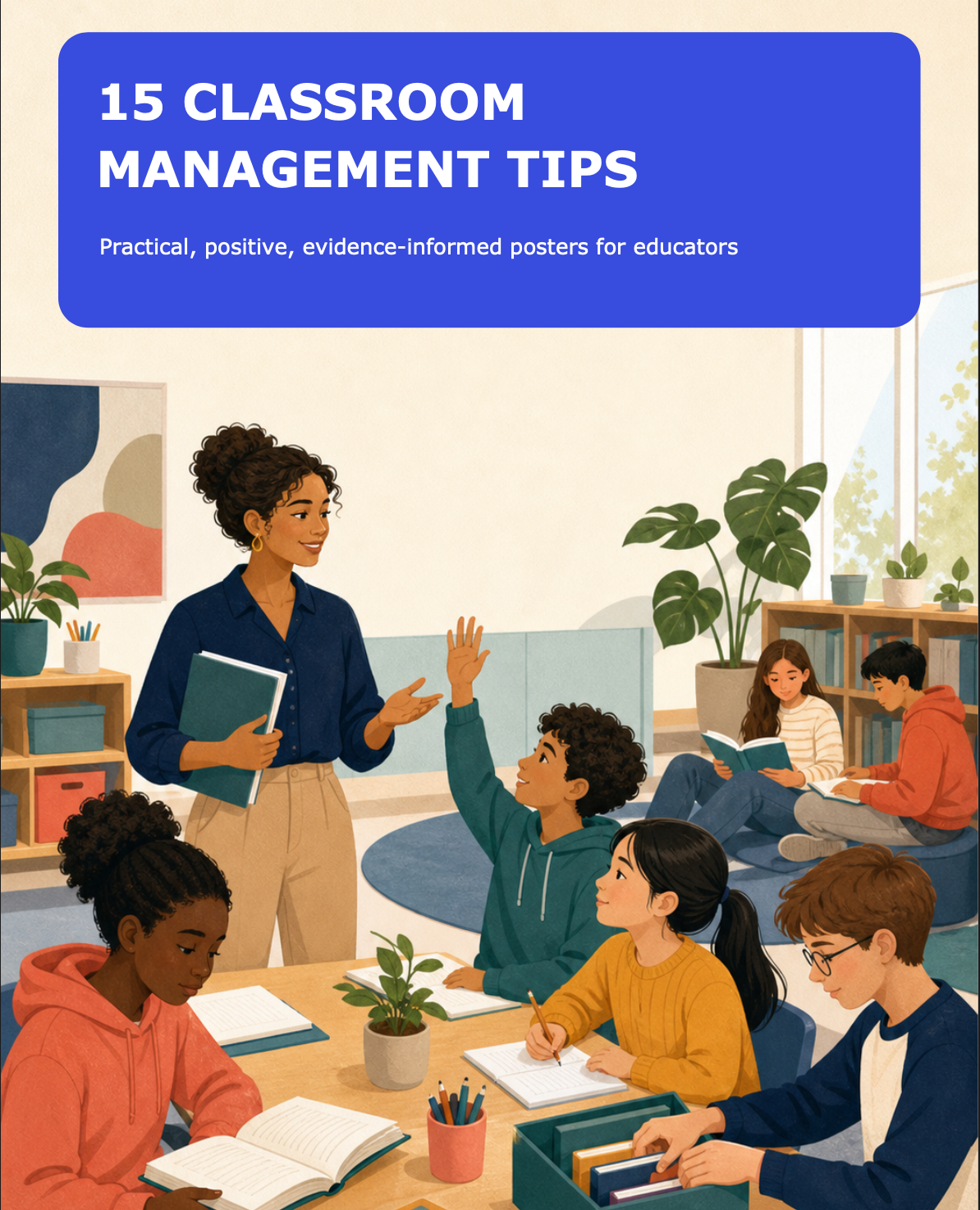
If you have found this article to be useful, you may also consider supporting my work by purchasing the summarised article in this PDF - 15 Classroom Management Tips For New Teachers. Here is a sample of a page from the pdf.
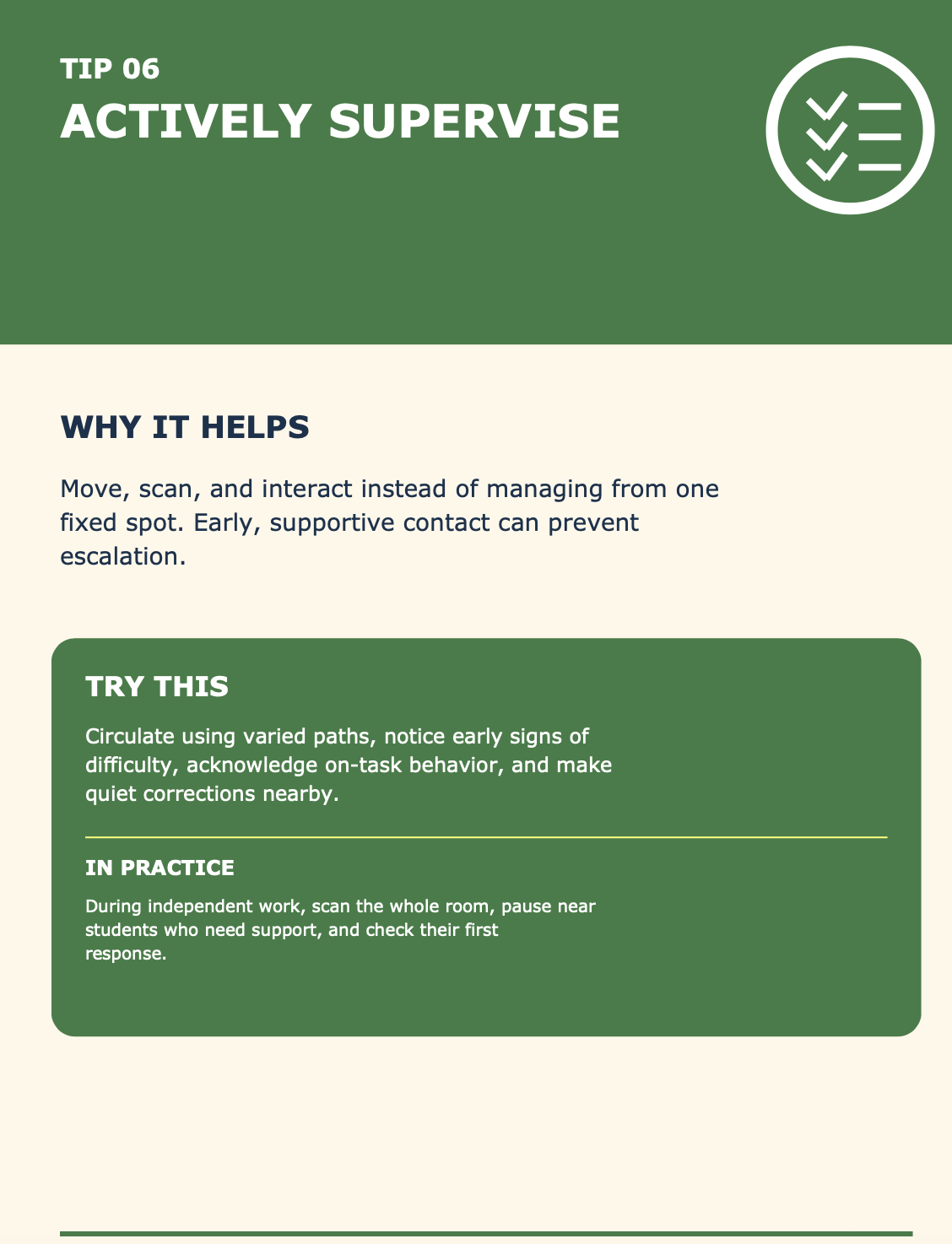
A sample page from my pdf.
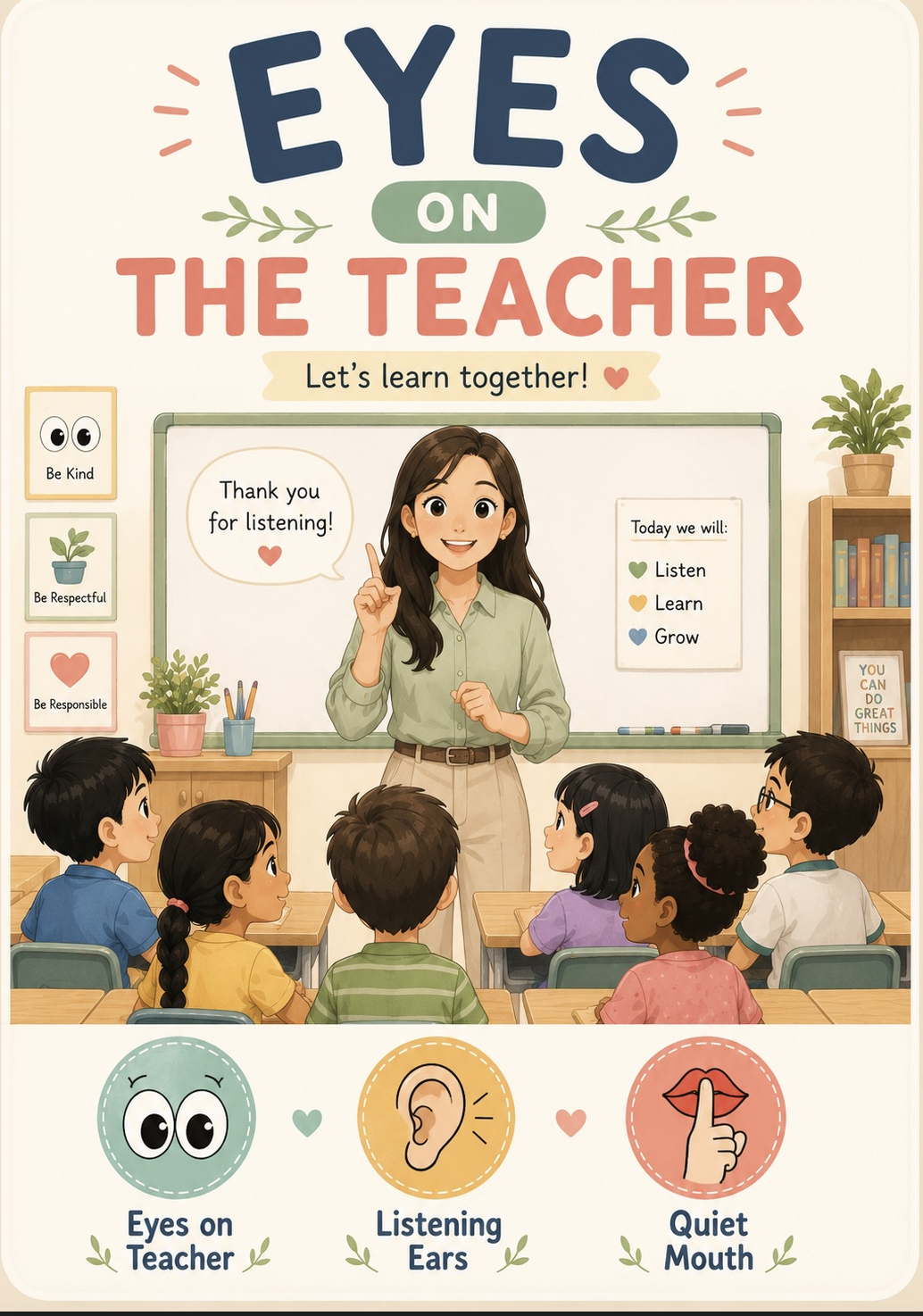
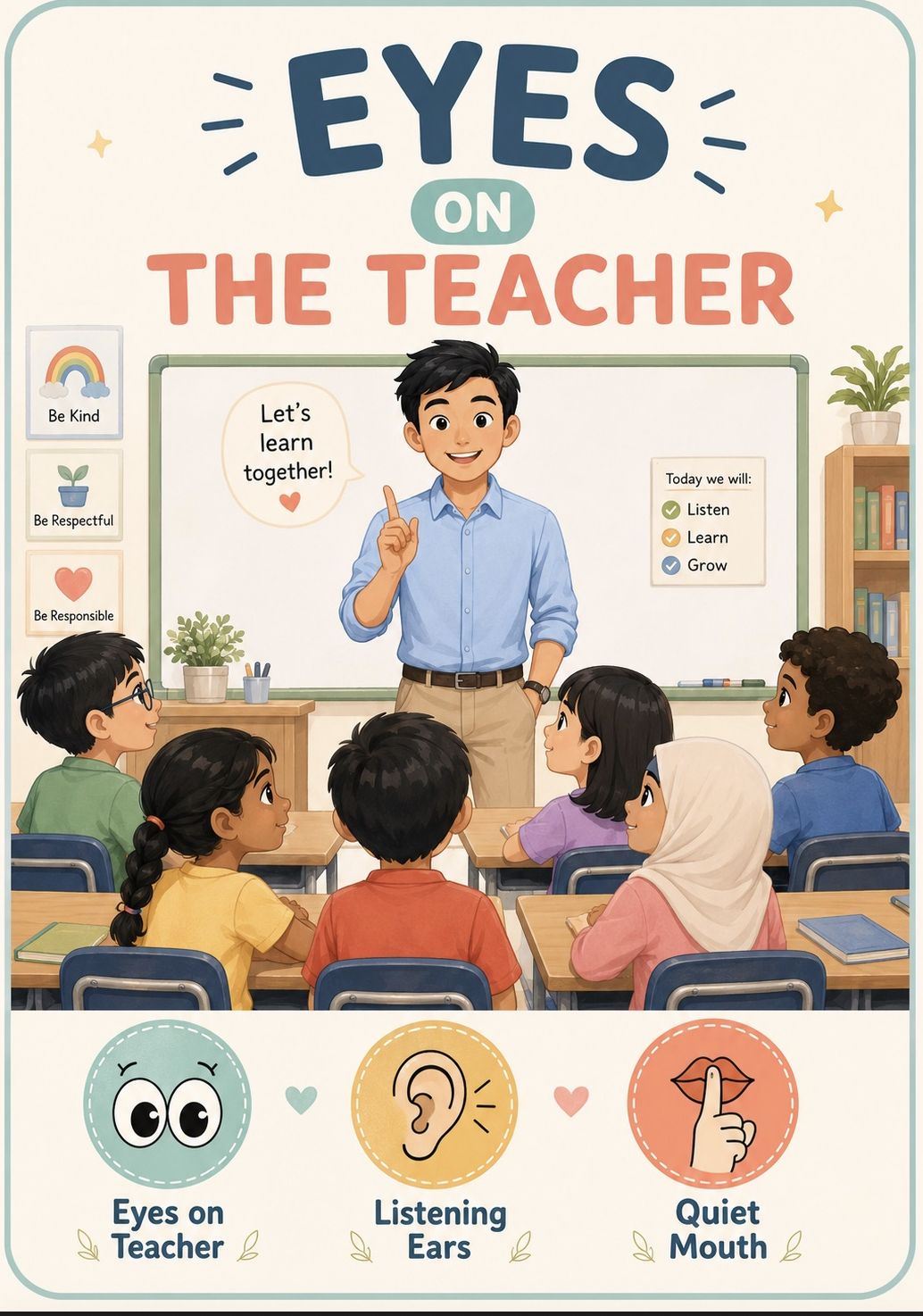
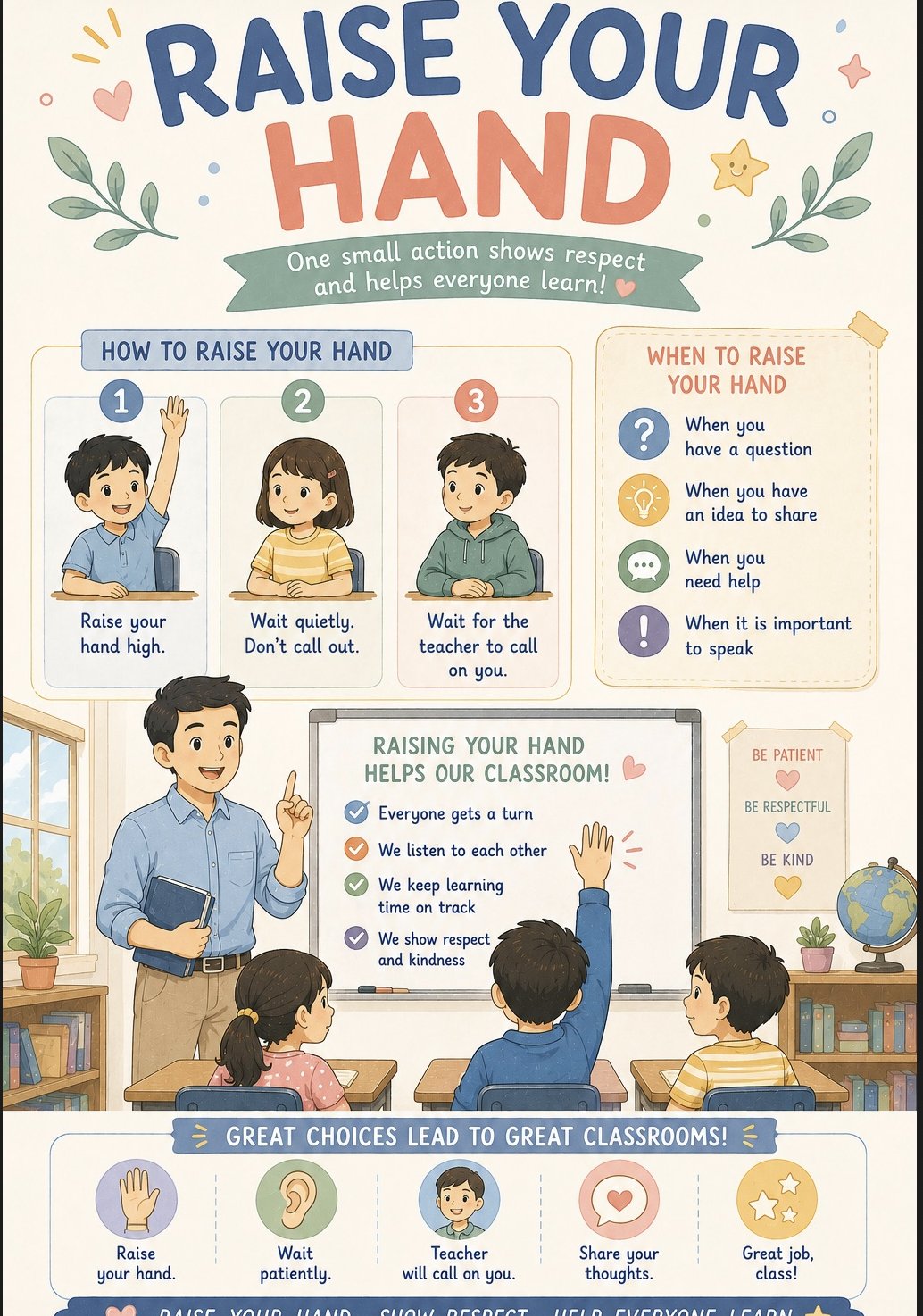
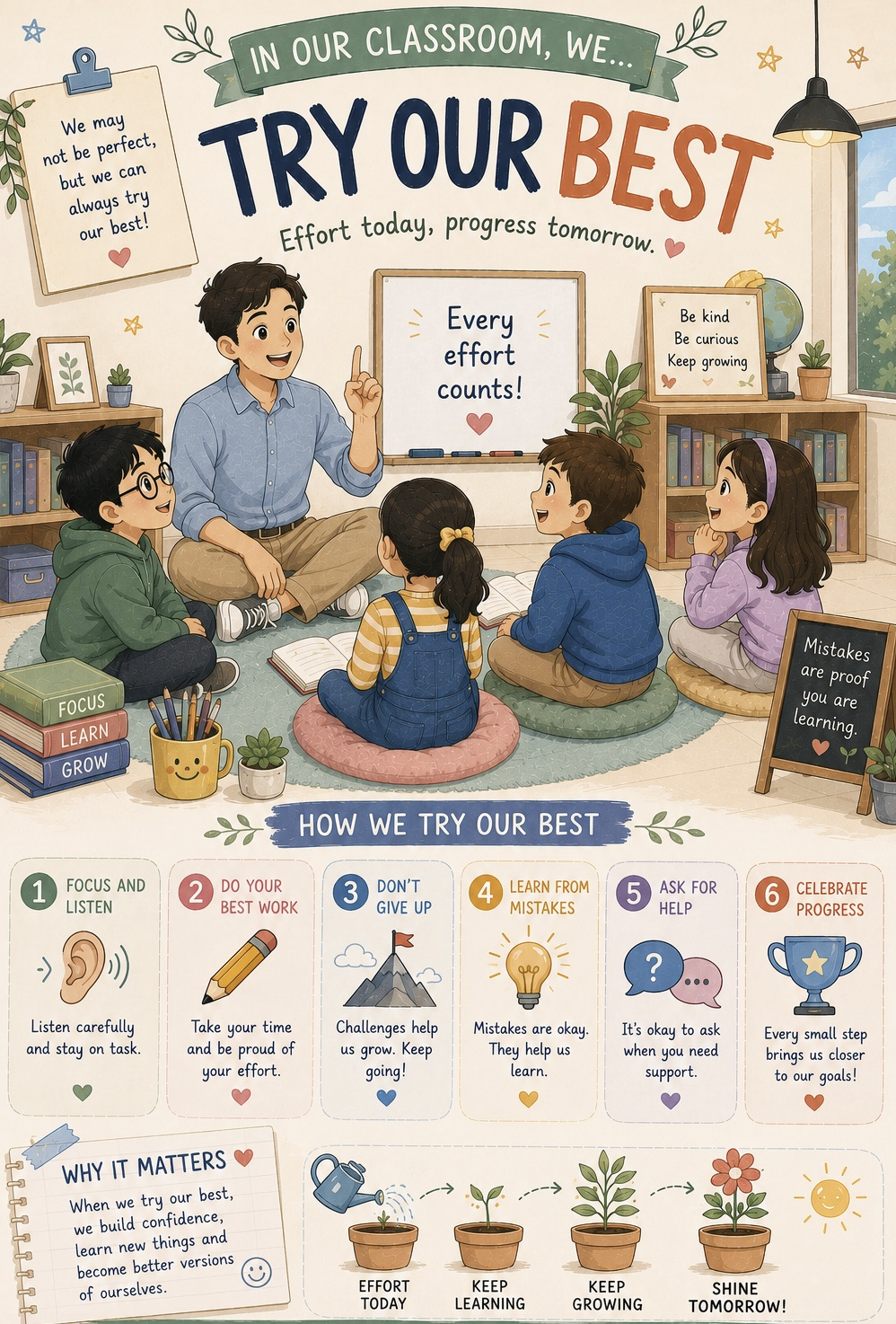
In it, I have also provided 23 full illustrated posters on 12 ideas.
Topics Included:
1) Eyes On Teacher
2) Raise Your Hand
3) Voice Levels
4) Ready To Learn
5) Kind Words
6) Walking Feet
7) Try Our Best
8) Think before you speak
9) Respect Classroom
10) Calm Down Corner
11) Mistakes help us learn
12) Listening Rules
There is a male / female version for the poster to complement your classroom.
Purchase these Classroom Management Posters here - Classroom Management Posters.pdf
This is a one time purchase where you can then share it in your school or classroom. Feel free to also share it with your colleagues.