Before You Choose Optimistic Waltz (ABRSM Grade 3 2027–2028): Honest Review
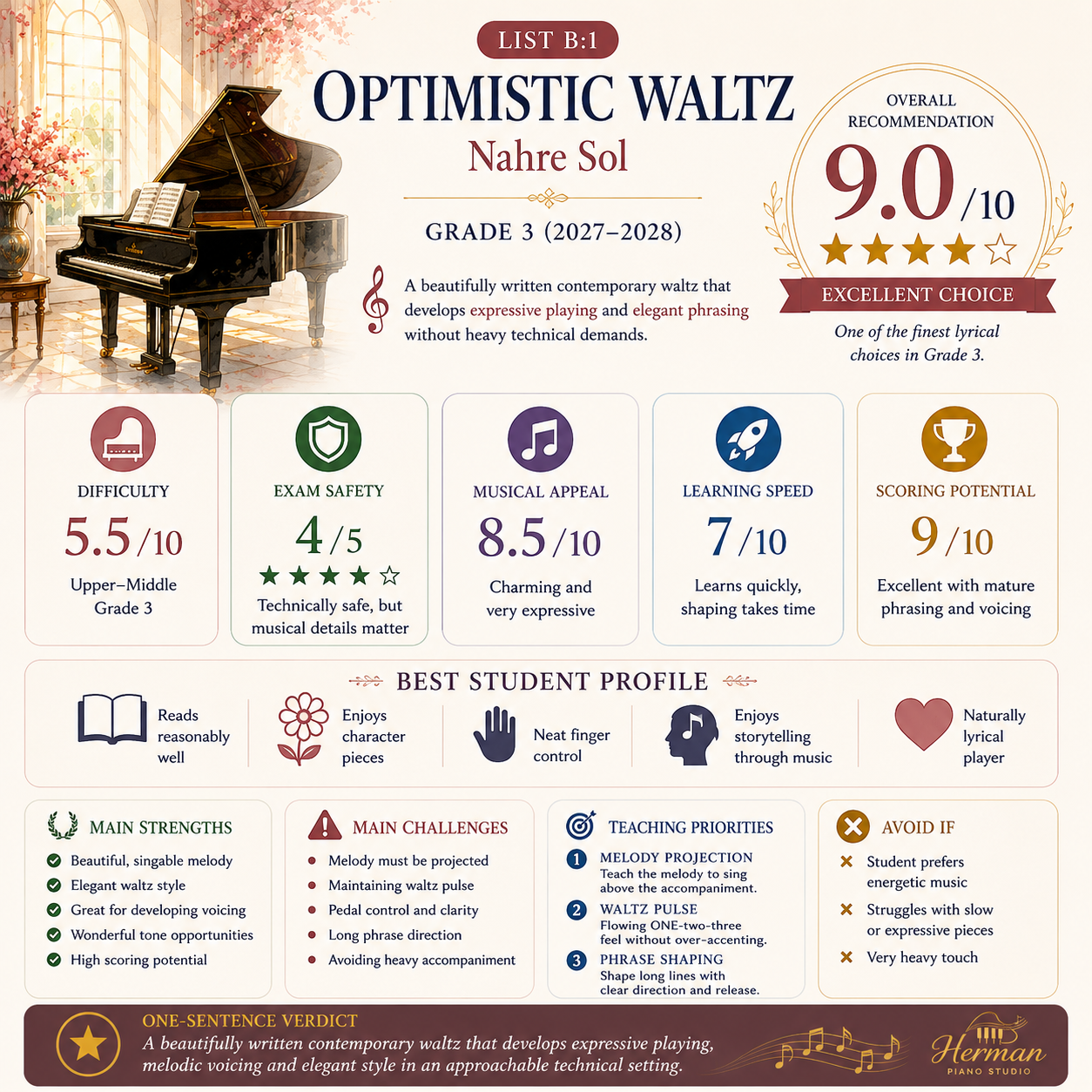
Here’s My Take on B1- Optimistic Waltz ( Nahre Sol )
Overall Verdict
One of the most musically mature pieces in the Grade 3 syllabus, despite having relatively modest technical demands.
This piece is not about fast fingers or difficult coordination. Instead, it introduces students to many skills associated with intermediate piano playing:
beautiful cantabile tone
elegant waltz rhythm
voicing the melody above the accompaniment
controlled pedalling
expressive phrasing
shaping long musical lines
Students who can already produce a singing tone will thrive. Students who rely purely on playing the correct notes may struggle to make the piece sound convincing.
Student Suitability Profile
👤 Ideal Student Expressive player with a naturally singing tone
📈 Learning Curve Moderate
🎹 Technical Demand Low-Moderate
🎼 Musical Demand High
🏆 Distinction Potential Excellent
⭐ Overall Recommendation
9/10 — One of the finest lyrical choices in the Grade 3 syllabus. It introduces students to expressive voicing, elegant waltz style and phrase shaping in an approachable technical setting. A thoughtful performance can sound remarkably mature for this level.
What Makes This Piece Difficult?
The challenge is not the notes.
The challenge is creating the illusion that the melody is floating effortlessly while the accompaniment quietly supports it.
For many Grade 3 students, this is their first experience of true melodic voicing.
Main Technical Challenges
1. Singing Melody
The RH melody should always be the focus.
Students often:
❌ play both hands equally loudly
2. Waltz Accompaniment
Although simplified, the accompaniment must still feel:
ONE-two-three
without becoming mechanical.
3. Pedal Control
The opening uses pedal.
Students should avoid:
blurred harmonies
changing pedal too late
4. Smooth Legato
The slurred melodic phrases should sound vocal rather than detached.
Main Musical Challenges
1. Waltz Character
Although marked “Optimistic”, this is not an energetic dance.
It should sound:
✓ graceful
✓ hopeful
✓ warm
rather than fast or exaggerated.
2. Long Phrase Direction
Many phrases extend over several bars.
Students should think in musical sentences rather than individual bars.
3. Dynamic Shaping
There are relatively few dynamics compared with Romantic repertoire.
Every change therefore becomes more important.
Common Student Mistakes
❌ Melody not projected
❌ Flat dynamics
❌ Heavy accompaniment
❌ Mechanical waltz pulse
❌ Excessive pedal
❌ Ignoring phrase direction
Teaching Priorities
Priority 1
Melody Projection
Teach the melody to “sing” above the accompaniment.
Priority 2
Waltz Pulse
Develop a flowing ONE-two-three feel without accenting every beat.
Priority 3
Phrase Shape
Identify where each phrase rises and falls.
Priority 4
Pedal
Use pedal to enhance resonance—not to hide uneven legato.
Exam Safety
⭐⭐⭐⭐☆ (4/5)
Technically very safe.
However, because the texture is transparent, examiners will quickly notice weaknesses in:
balance
phrasing
tone
musical shape
One-Sentence Recommendation
A beautifully written contemporary waltz that develops expressive playing, melodic voicing and elegant dance style without placing excessive technical demands on the student.
—————————————————————————
If you’re looking for a piano teacher near Tampines mall or searching for piano lessons in Tampines, Herman Piano Studio specialises in ABRSM piano tuition from beginners to advanced levels. Every lesson focuses on developing confident technique, musical understanding and examination success.
You may wish to support my work via donation through this PayPal link -
https://paypal.me/hermanpianostudio
Thanks In Advance.
