ABRSM Grade 4 Aural: Character – How to Answer with Confidence
Introduction
If you’ve ever wondered what the examiner means when they ask, “What is the character of this piece?”, you’re not alone. This is one of the most common questions in the ABRSM Grade 4 Aural Test, and it’s also one that many students worry about.
The good news is that you don’t need to know complicated music theory or use fancy musical words. The examiner isn’t looking for the “perfect” answer—they simply want to know whether you can listen carefully, recognise the overall mood of the music, and explain what musical features helped you come to that conclusion.
Once you learn which musical clues to listen for, answering the Character question becomes much more straightforward. With a little practice, you’ll begin to hear the music in a completely different way.
Once you know what musical clues to listen for, the answer almost reveals itself.
What Does “Character” Mean?
When the examiner asks about the character of a piece, they are asking one simple question:
How does the music make you feel?
Think of music like a story. Every story has a different mood.
Some stories make you laugh.
Some feel peaceful.
Others are exciting or mysterious.
Music works in exactly the same way.
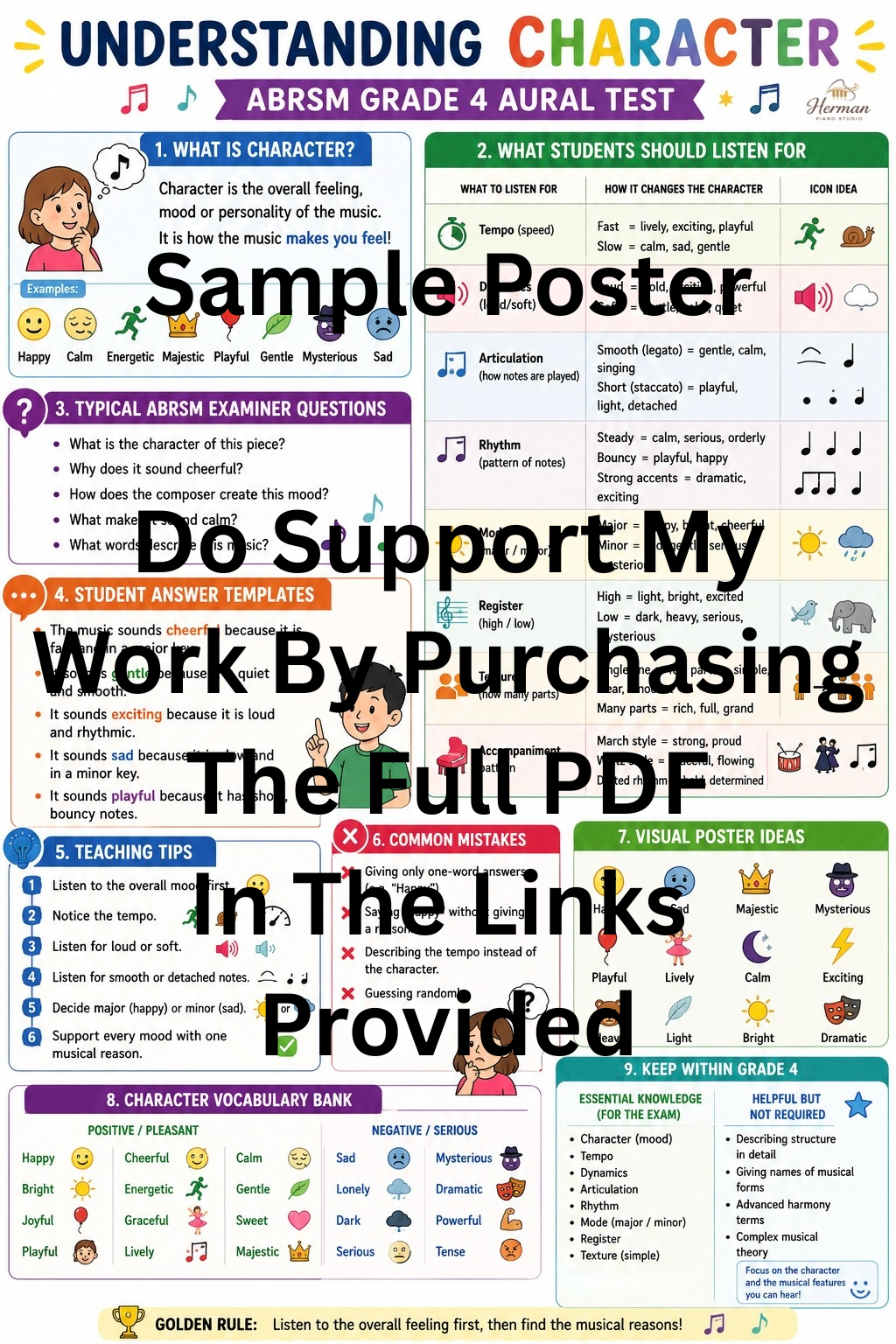
Here are some common character words you might use:
😊 Cheerful
🌿 Calm
🎈 Playful
🕵️ Mysterious
👑 Majestic
😢 Sad
⚡ Exciting
🎵 Gentle
Don’t worry about choosing the “perfect” adjective. In many cases, more than one answer could be correct as long as you can explain your reason.
The Secret to Answering Correctly
Many students think they need to analyse every note.
Actually, you only need two simple steps.
Step 1: Choose ONE Mood
Ask yourself:
“How does this music make me feel?”
For example:
Cheerful
Calm
Playful
Sad
Majestic
Mysterious
Choose the word that best matches the overall feeling.
Step 2: Explain Why
Now support your answer with one or two musical reasons.
A very useful sentence pattern is:
The music sounds ______ because ______.
Here are some examples.
The music sounds cheerful because it is fast and in a major key.
The music sounds calm because it is quiet and smooth.
The music sounds playful because it has short, bouncy notes.
The music sounds majestic because it is loud and has strong chords.
The music sounds mysterious because it is slow and in a minor key.
Notice that every answer has two parts:
Character + Musical reason
This is exactly what the examiner wants to hear.
What Musical Clues Should You Listen For?
Instead of listening to every note, train yourself to listen for a few important musical clues.
Musical Feature
What To Listen For
Possible Character
1.Tempo - Fast or slow speed
Fast = lively, slow = calm or gentle
2.Dynamics - Loud or soft playing
Loud = bold, soft = peaceful
3.Articulation - Smooth or detached notes
Legato = gentle, staccato = playful
4.Rhythm - Even, bouncy or strongly accented
Bouncy = playful, strong = dramatic
5.Major / Minor - Bright or darker sound
Major = cheerful, minor = mysterious or sad
6.Register - High or low notes
High = light, low = serious
7.Texture - Few or many musical parts
Thin = simple, thick = grand
8.Accompaniment - Pattern supporting the melody
Waltz = graceful, march = proud
Don’t try to identify every feature at once.
Usually, two or three clues are enough to give a confident answer.
Common Mistakes
Many students lose confidence because of a few simple mistakes.
❌ Giving only one word
Instead of saying:
“Happy.”
Try saying:
“The music sounds cheerful because it is fast and in a major key.”
❌ Saying the mood without explaining why
The examiner wants to know how you reached your answer.
Always give at least one musical reason.
❌ Describing the music instead of the character
This answer isn’t complete:
“It’s fast.”
A better answer is:
“It sounds lively because it is fast.”
Tempo helps explain the character—it isn’t the character itself.
❌ Guessing randomly
Even if you’re unsure, listen for one clear clue.
Ask yourself:
Is it fast or slow?
Loud or soft?
Major or minor?
These clues will often point you towards a suitable character.
Quick Exam Tips
🎧 Listen to the overall feeling before analysing details.
😊 Pick one mood that best fits the music.
🎼 Give at least one musical reason.
🗣 Use simple, clear words.
🎵 Listen for tempo and dynamics first.
🎹 Remember that more than one adjective can sometimes be acceptable.
💬 Speak confidently, even if your answer isn’t identical to someone else’s.
✔️ Support every character word with musical evidence.
Use This Character Reference Chart
If you’re revising for the ABRSM Grade 4 Aural Test, keeping a one-page visual reference beside your piano can make practice much easier.
The Grade 4 Character Reference Chart brings together the key ideas you’ll need in one place, including:
common character vocabulary
important musical clues to listen for
simple answer templates
common examiner questions
frequent mistakes to avoid
essential Grade 4 knowledge
Instead of searching through pages of notes, you can quickly glance at the chart before or after each listening exercise. Many students also find it helpful to use the chart during home practice until recognising musical character becomes second nature. The accompanying poster covers these points in a colourful, easy-to-follow format designed specifically for Grade 4 learners. It provides visual reminders of the musical features discussed throughout this article and can be used as a quick revision aid.
You can view the complete printable poster here:
https://www.hermanpianostudio.com/store/p/abrsm-grade-4-aural-character-reference-chart
Conclusion
Answering the Character question is much easier than many students think. Instead of trying to analyse every detail, focus on the overall feeling of the music, choose one suitable character word, and explain your answer using one or two musical clues. With regular listening practice, this process will soon become natural and you’ll feel much more confident during your ABRSM Grade 4 Aural Test.
If you’re looking for a piano teacher in Tampines who prepares students for ABRSM exams with structured, easy-to-understand resources, Herman Piano Studio offers personalised piano lessons that build confidence in both practical and aural skills.
