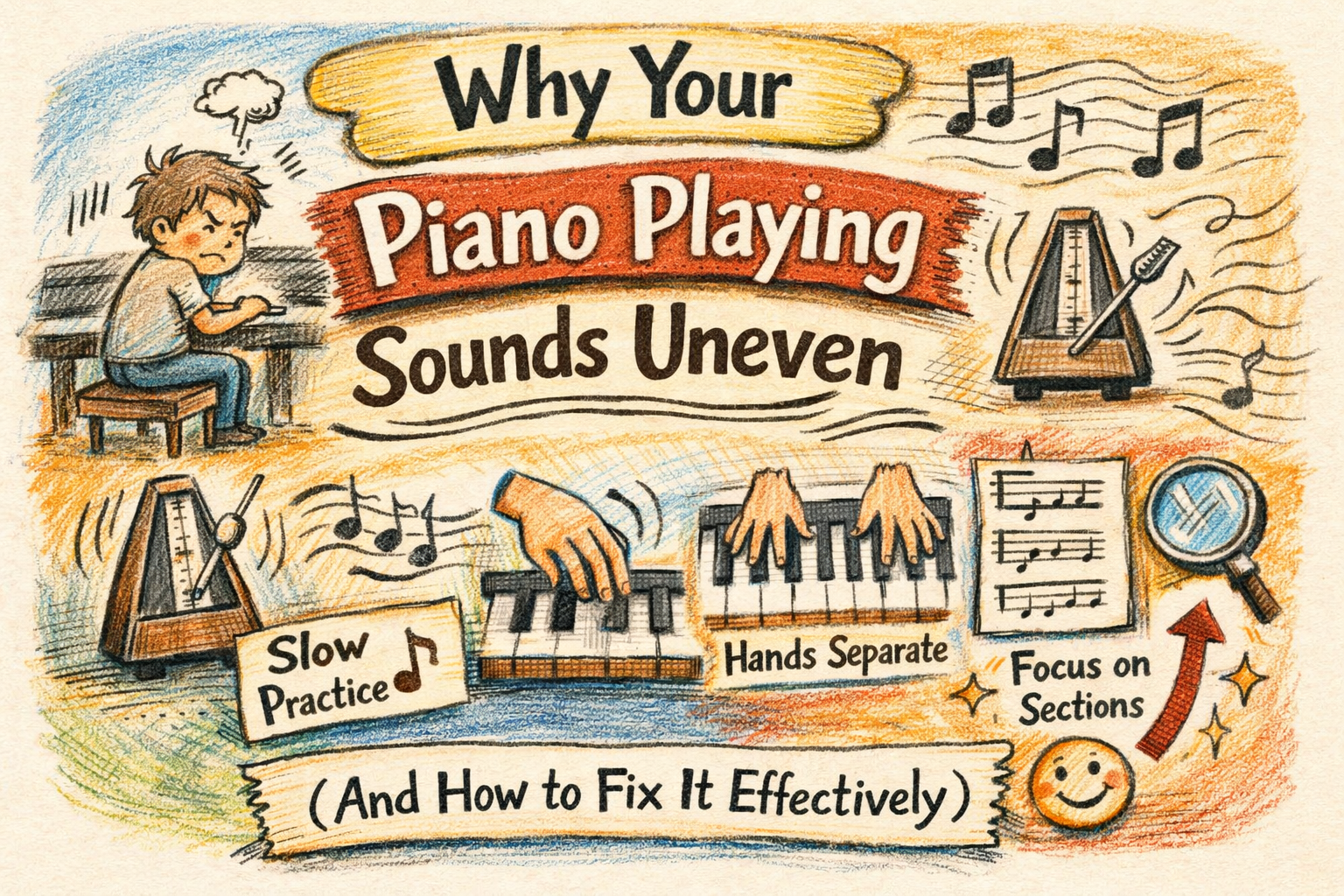
Why Your Piano Playing Sounds Uneven (And How to Fix It Effectively)
Introduction
Have you ever practised a piece many times, only to realise that your playing still sounds uneven or inconsistent?
This is a very common issue among students, especially those taking piano lessons for beginners or preparing for exams.
Parents may notice that their child:
Plays some notes louder than others unintentionally
Speeds up and slows down unevenly
Struggles to maintain a steady flow
Students often feel frustrated because even after practising, the music does not sound smooth.
The good news is that uneven playing is not a sign of lack of talent—it is usually a technical and practice-related issue that can be fixed with the right approach.
In this article, we will explore why piano playing becomes uneven and provide clear, practical piano practice tips to solve it.
What Does “Uneven Playing” Mean?
Uneven playing can appear in several ways:
Irregular rhythm (rushing or dragging)
Inconsistent finger control
Uneven tone between notes
Lack of coordination between hands
Even at beginner level, developing evenness is essential for musical clarity and control.
Why Piano Playing Becomes Uneven
1. Weak Finger Control
Each finger has different strength levels. For example:
Fingers 4 and 5 are naturally weaker
Stronger fingers may play louder unintentionally
Without proper training, this leads to uneven sound.
2. Playing Too Fast Too Soon
Many students try to play at full speed before they are ready.
This causes:
Loss of control
Increased mistakes
Uneven rhythm
This is one of the most common issues seen in beginner piano lessons.
3. Lack of Rhythmic Awareness
Students who do not internalise rhythm properly may:
Rush certain passages
Slow down unintentionally
Lose steady pulse
A strong sense of rhythm is essential for even playing.
4. Poor Hand Coordination
When both hands play together, coordination becomes more complex.
If one hand is less secure, the result is:
Uneven timing
Misaligned notes
Inconsistent flow
5. Ineffective Practice Methods
Repeating a piece from start to finish without focusing on problem areas often reinforces uneven playing.
This is why understanding how to learn piano effectively is crucial.
Practical Tips to Fix Uneven Playing
1. Practise Slowly With Control
Slow practice is one of the most powerful tools.
Benefits include:
Better finger control
Improved accuracy
Stronger coordination
Play at a tempo where you can control every note evenly.
2. Use a Metronome
A metronome helps develop steady rhythm.
Start at a slow tempo and:
Ensure each note aligns with the beat
Gradually increase speed
Maintain control at all times
This is one of the most effective piano practice tips for improving consistency.
3. Practise Hands Separately
If coordination is an issue:
Practise right hand alone
Practise left hand alone
Combine only when both are secure
This builds confidence and control in each hand.
4. Focus on Small Sections
Instead of playing the whole piece:
Work on 2–4 bars at a time
Repeat until evenness improves
Gradually connect sections
This targeted approach leads to faster improvement.
5. Train Finger Strength
Simple exercises such as scales and finger drills help develop:
Finger independence
Strength balance
Control
These are essential for long-term progress.
6. Listen Carefully While Playing
Students often focus on “playing notes” rather than listening.
Train yourself to notice:
Are all notes equal in tone?
Is the rhythm steady?
Does the music flow smoothly?
Listening actively is a key part of learning how to learn piano properly.
Common Mistakes That Make Uneven Playing Worse
Ignoring Mistakes
Repeating uneven playing without correction reinforces bad habits.
Practising Too Fast
Speed should never come at the expense of control.
Skipping Fundamentals
Neglecting scales and exercises weakens technical development.
Lack of Patience
Evenness takes time to develop. Rushing the process often leads to frustration.
Conclusion
Uneven piano playing is a common challenge, especially for beginners.
However, it is completely fixable with the right approach.
By focusing on:
Slow, controlled practice
Rhythmic accuracy
Finger strength
Careful listening
students can gradually develop smooth and even playing.
Whether you are a student or a parent exploring piano lessons for beginners, understanding these principles can make a significant difference in progress.
Working with a knowledgeable piano teacher in Singapore can also help identify specific issues and guide students toward more effective practice habits.
With consistency and the right techniques, your playing can become not only even—but also expressive and confident.
