How Long Does It Take to Learn Piano? A Realistic Guide for Beginners
Introduction
One of the most common questions people ask before starting piano lessons is:
“How long does it take to learn piano?”
Parents often ask this when considering piano lessons for children, while adults frequently wonder whether it is too late to start learning the instrument.
The truth is that learning piano is not a race with a fixed finish line. Instead, it is a gradual process where skills build step by step. With consistent practice and proper guidance, beginners can make meaningful progress within a surprisingly short time.
In this article, we will explore how long it typically takes to learn piano, what factors affect learning speed, and how students can improve efficiently through structured beginner piano lessons and good piano practice tips.
What Does “Learning Piano” Actually Mean?
Before discussing timelines, it is important to clarify what “learning piano” means.
Different students have different goals:
Playing simple songs for enjoyment
Passing graded piano exams such as ABRSM
Playing classical repertoire confidently
Performing advanced pieces
Because of these different goals, learning piano can mean different things.
For example:
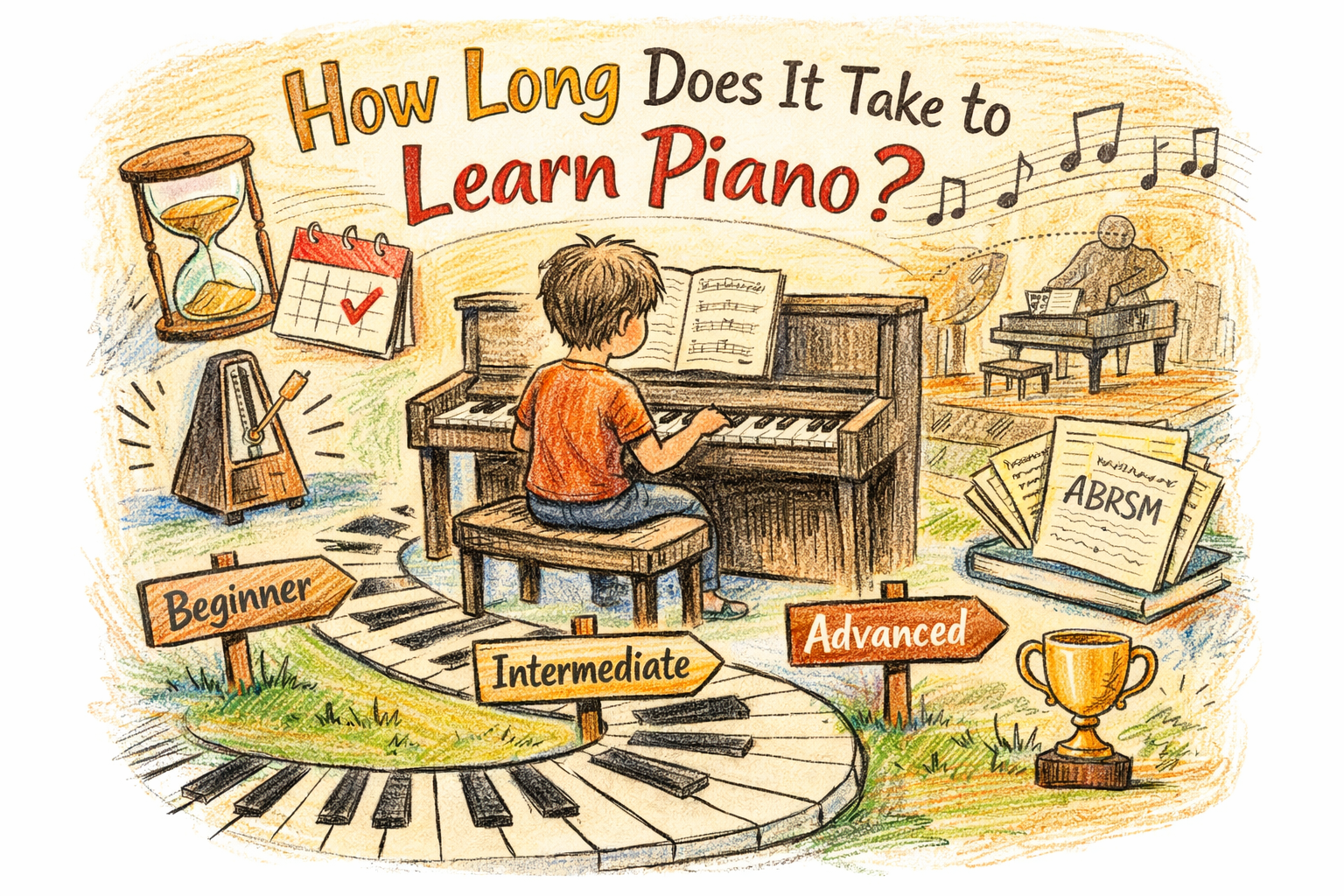
Basic piano skills
Students can usually play simple melodies and chords.
Intermediate piano ability
Students can play full pieces with both hands and interpret musical markings.
Advanced piano playing
Students can perform complex repertoire and develop musical expression.
Understanding these stages helps students and parents set realistic expectations when beginning piano lessons for beginners.
Typical Timeline for Piano Progress
While every student learns at a different pace, experienced teachers generally observe the following timeline.
First 1-6 Months: Foundations
During the first few months, beginners focus on:
Reading basic music notation
Understanding rhythm
Developing hand coordination
Learning simple pieces
Students may begin playing short melodies with both hands by the end of this stage.
This early progress is often very encouraging for students who are just learning how to learn piano.
6–23 Months: Early Musical Development
After several months of regular practice, students begin to develop stronger control and confidence.
At this stage, students typically learn:
Scales and simple technical exercises
Basic musical expression such as dynamics
More complex rhythms
Pieces that require coordination between both hands
Many students taking beginner piano lessons reach this stage within their first year of study.
2–6 Years: Intermediate Playing
Students who practise consistently and take regular lessons can reach an intermediate level after a few years.
They may be able to play:
Classical repertoire from composers such as Bach, Mozart, or Beethoven
Pieces that require musical phrasing and articulation
Music with more advanced rhythms and textures
Students preparing for ABRSM examinations often reach this stage around Grades 3–5, depending on their practice habits.
7+ Years: Advanced Development
More advanced repertoire requires deeper musical understanding and stronger technical control.
Students at this stage often work on:
Expressive interpretation
Advanced technical passages
Performance preparation
Reaching an advanced level usually takes many years of consistent study, but the journey itself is highly rewarding.
Factors That Affect How Fast Someone Learns Piano
Not all students progress at the same speed. Several factors influence how quickly someone improves.
Practice Consistency
The most important factor is consistent practice.
A student who practises 20–30 minutes every day often improves faster than someone who practises several hours only once a week.
Consistency allows the brain and muscles to gradually develop coordination.
Quality of Practice
Another key factor is how students practise.
Effective practice includes:
Working on difficult passages
Practising slowly
Listening carefully while playing
Good piano practice tips can make a huge difference in how quickly students progress.
Guidance From a Good Teacher
Learning with an experienced teacher provides important structure and feedback.
A skilled piano teacher in Singapore can help students:
Correct technical mistakes early
Choose appropriate repertoire
Develop good practice habits
Prepare for performances or exams
Professional guidance helps students avoid developing habits that may slow their progress.
Age and Learning Goals
Both children and adults can learn piano successfully.
Children often develop coordination and musical instincts quickly, while adults may progress faster in understanding musical concepts.
The key is not age, but consistent effort and clear learning goals.
Practical Tips for Learning Piano Faster
Students who want to progress efficiently can follow several simple strategies.
Practise a Little Every Day
Daily practice builds muscle memory and strengthens musical understanding.
Even 15–30 minutes a day can lead to steady progress.
Focus on Difficult Sections
Instead of always playing the entire piece, focus on the parts that need improvement.
Working on small sections often produces faster results.
Practise Slowly
Slow practice helps students play accurately and avoid mistakes becoming permanent habits.
Accuracy should always come before speed.
Listen to Good Performances
Listening to recordings of professional pianists helps students understand musical phrasing and interpretation.
This is especially helpful when preparing exam repertoire.
Be Patient With Progress
Learning piano is a long-term skill. Small improvements each week gradually add up to significant progress over time.
Common Misconceptions About Learning Piano
Many beginners have unrealistic expectations about how quickly they should improve.
“I Should Be Good After a Few Months”
While beginners can play simple pieces within months, developing musical fluency takes time.
Even professional pianists continue improving throughout their lives.
“Talent Is More Important Than Practice”
Natural ability can help, but consistent practice and good teaching are far more important.
Most successful pianists developed their skills through disciplined practice.
“Adults Learn Piano Too Slowly”
Adults often learn very effectively because they understand instructions clearly and practise with intention.
It is never too late to begin learning piano.
Conclusion
Learning piano is a gradual and rewarding journey.
While beginners may start playing simple pieces within a few months, developing strong musical skills takes time, patience, and consistent effort.
With regular practice, structured lessons, and guidance from an experienced piano teacher in Singapore, students of all ages can make steady progress and enjoy the process of learning music.
Whether your goal is to play for enjoyment, prepare for exams, or develop serious musical skills, the most important step is simply to begin.
With dedication and good piano practice tips, learning piano can become one of the most fulfilling skills you develop.
If You are looking for a piano teacher in Tampines? Reach out to me for more information.
