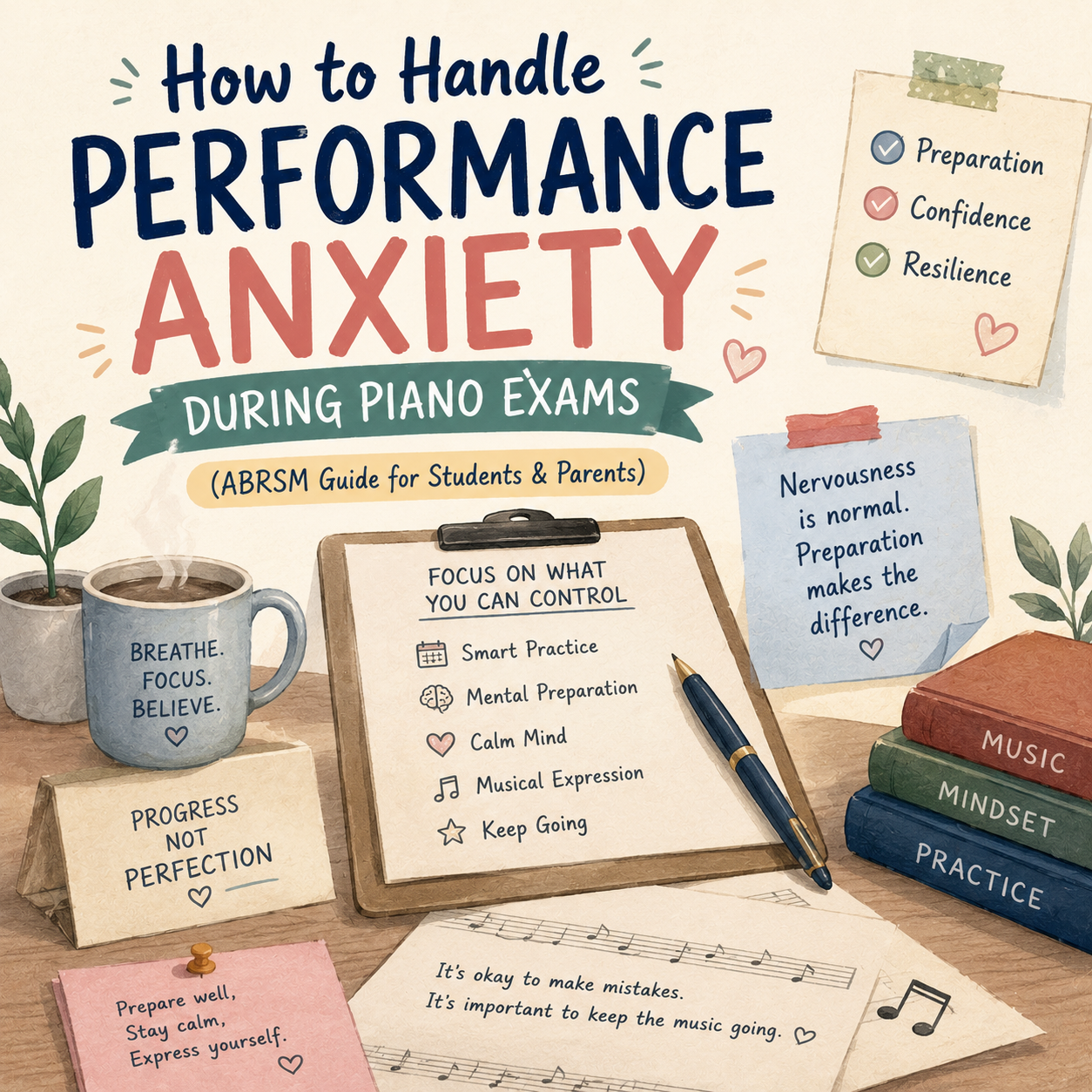
How to Handle Performance Anxiety During Piano Exams (ABRSM Guide for Students and Parents)
Introduction
Feeling nervous before a piano exam is extremely common.
In fact, even experienced pianists and professional performers still experience some level of performance anxiety before going on stage.
For many students taking an ABRSM piano exam, the pressure can feel overwhelming because piano playing is both physical and mental at the same time.
Students are not only trying to remember notes and rhythms.
They are also trying to manage:
- memory
- concentration
- physical coordination
- emotions
- self-pressure
- fear of mistakes
This is why piano exam anxiety is not simply “lack of preparation.”
Often, even well-prepared students can become nervous under pressure.
The good news is:
👉 Performance anxiety can be managed and improved with the right preparation approach.
The goal is not to become completely fearless.
The goal is to become more psychologically prepared and resilient during performances.
Why Piano Exams Feel So Stressful
1. Fear of Mistakes
Many students believe:
“If I make one mistake, everything is ruined.”
This creates enormous tension before the exam even begins.
In reality, examiners are usually assessing:
- musical continuity
- rhythm stability
- tone quality
- overall control
- recovery ability
- not absolute perfection.
Ironically, students who fear mistakes excessively often become more tense physically, which increases the likelihood of slips.
2. Fear of Memory Slips
Memory slips are one of the biggest fears during piano exams.
This is especially common in:
- teenagers
- perfectionist students
- adult learners returning to piano
Many students can play confidently at home, but under pressure, the brain suddenly becomes less reliable.
This happens because anxiety affects concentration and working memory.
This does not mean the student is untalented.
It simply means the brain is under stress.
3. Pressure From Parents or Self-Expectations
Sometimes the pressure comes externally.
Sometimes it comes internally.
Students may feel:
- afraid of disappointing parents
- embarrassed about making mistakes
- guilty about not practising enough
- anxious about exam results
Adult students may also place extremely high expectations on themselves because they compare themselves to advanced performers online.
Over time, this can create unhealthy perfectionism.
4. Being Watched by Examiners
At home, students usually practise in a familiar and safe environment.
But in an exam:
- the room feels unfamiliar
- the piano feels different
- someone is observing closely
- silence feels more intense
This sudden change in environment alone can trigger piano performance anxiety.
5. Perfectionism
Perfectionism is one of the most common causes of piano exam anxiety.
Many students unknowingly train themselves to panic whenever something goes wrong.
For example:
- restarting immediately after mistakes
- becoming frustrated over tiny slips
- expecting every practice run to be perfect
Over time, the brain begins associating mistakes with danger.
This creates fear during performances.
The Biggest Mistake Students Make
1. Constant Restarting During Practice
One of the most damaging practice habits is constantly restarting after small mistakes.
This teaches the brain:
> “Mistakes are unacceptable.”
But during a real performance, there is no restart button.
Students who constantly restart often struggle to recover calmly during exams.
2. Obsessing Over Perfection
Many students think confidence comes from eliminating every mistake.
But in reality:
👉 Confidence often comes from learning how to continue despite imperfections.
Students who can recover calmly usually perform better under pressure than students trying to force perfection.
3. Only Practising in “Safe Environments”
Some students only practise:
- alone
- in the same room
- without recording
- without anyone listening
Then exam day becomes their first real “performance experience.”
Naturally, the pressure feels overwhelming.
Performance is a skill by itself.
It must also be practised gradually.
Practical Strategies to Handle Piano Performance Anxiety
1. Simulated Performances
Students should regularly simulate exam conditions at home.
For example:
- walk to the piano properly
- announce the piece mentally
- perform from beginning to end
- avoid stopping midway
- practise bowing calmly after finishing
This helps reduce the shock of real performance situations.
2. Record Yourself Frequently
Recording yourself is surprisingly helpful for piano exam preparation.
Why?
Because the red recording light creates mild psychological pressure.
Students often notice:
- shaky rhythm
- rushing
- memory insecurity
- tension
- loss of concentration
This is useful training.
Over time, students become more mentally stable under observation.
3. Practise Not Stopping.
One of the most important performance skills is learning how to continue after mistakes.
During practice:
- do not stop immediately after slips
- keep the pulse moving
- recover smoothly
- train musical continuity
Examiners are usually more concerned about overall musical flow than tiny isolated errors.
4. Slow Down Your Breathing Before Playing
Performance anxiety often causes:
- shallow breathing
- increased heart rate
- muscular tension
Before beginning:
- inhale slowly
- exhale slowly
- release shoulder tension
- avoid rushing to start
Even 15–20 seconds of calm breathing can help stabilise the nervous system.
5. Prepare Mentally — Not Just Musically
Many students only prepare the fingers.
But piano exams are also mental events.
Students should mentally rehearse:
- walking into the room
- handling small mistakes calmly
- continuing confidently
- recovering from memory insecurity
Mental preparation reduces shock during the actual exam.
6. Keep Realistic Expectations
This is especially important for perfectionist students.
A good performance does not mean:
- zero mistakes
- robotic accuracy
- tension-free playing
A strong performance usually means:
- stable rhythm
- musical communication
- emotional control
- recovery ability
- continuity
Even advanced pianists make mistakes during live performances.
7. Learn Recovery Skills
One important but overlooked skill is:
👉 recovering after something goes wrong.
Many students panic because they never practised recovery.
Students should learn:
- how to find the beat again
- how to continue after slips
- how to simplify mentally under stress
- how to stay emotionally calm
This builds genuine resilience.
8. Prepare Properly on Exam Day
On the actual exam day:
- avoid over-practising excessively
- warm up calmly
- avoid panic repetitions
- arrive earlier
- maintain stable energy levels
Trying to “force confidence” at the last minute usually increases anxiety.
Good preparation is built gradually over weeks and months.
What Parents Should Understand
Avoid Excessive Pressure
Many children already place significant pressure on themselves.
Sometimes even well-meaning comments can unintentionally increase anxiety.
For example:
- “Don’t make careless mistakes.”
- “You practised so much already.”
- “You must do well.”
Instead, calmer support is often more helpful.
Focus on Progress — Not Just Marks
Piano learning is long-term.
A single exam result does not define:
- musical potential
- intelligence
- future ability
Often, the emotional experience during piano learning matters more than the actual grade.
Emotional Support Matters
Students usually perform better when they feel:
- psychologically safe
- emotionally supported
- accepted even if mistakes happen
Confidence grows best in stable emotional environments.
Final Thoughts
Piano performance anxiety is extremely normal.
In fact, it is part of learning how to perform music under pressure.
Confidence is usually not built through “thinking positively.”
It is built through:
- repeated exposure
- healthy preparation habits
- psychological resilience
- realistic expectations
- learning how to recover calmly
Most importantly:
👉 Nervousness does not mean failure.
Many excellent performances still contain nerves.
The goal of piano exams should not be perfection.
The deeper goal is musical growth, resilience, and long-term confidence at the piano.
At Herman Piano Studio, we believe that healthy piano learning should focus not only on technical accuracy, but also on building long-term confidence, resilience, and psychologically healthy practice habits.
For students struggling with piano performance anxiety, structured and supportive piano lessons can make a significant difference in helping students gradually become more confident under pressure.
