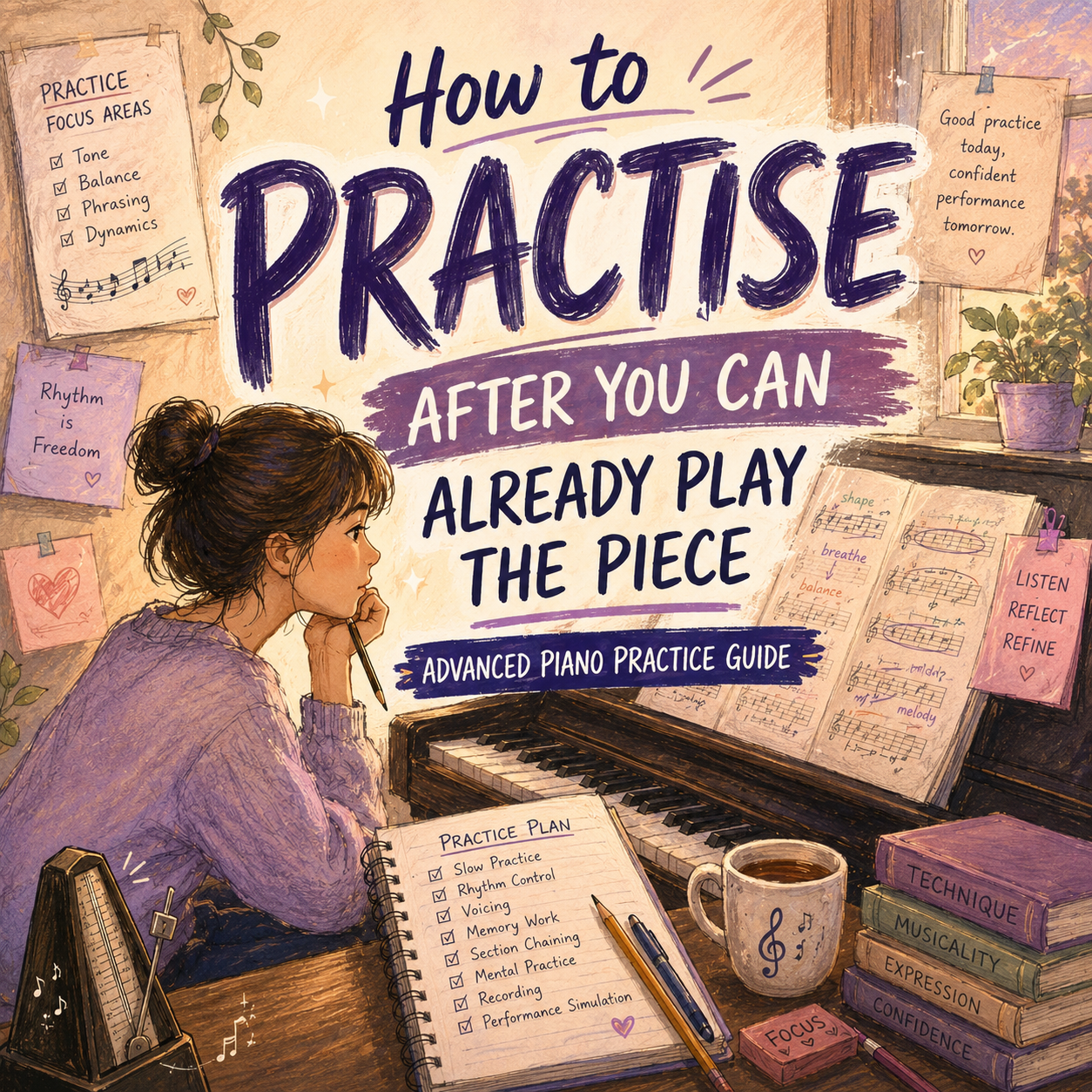
How to Practise After You Can Already Play the Piece (Advanced Piano Practice Guide)
Introduction
One of the biggest misunderstandings in piano learning is this:
“If I can play through the piece from beginning to end, I’m done.”
In reality, that is usually only the beginning of serious piano work.
Many students — especially intermediate and advanced learners — eventually reach a frustrating plateau where they can technically play the notes, but the performance still feels unstable, inconsistent, or musically unconvincing.
This is extremely common during ABRSM piano preparation.
Students may notice problems such as:
uneven rhythm
inconsistent memory
tension in difficult passages
unreliable performance under pressure
weak tone control
lack of musical shaping
mistakes appearing randomly during performances
This stage can feel confusing because from the outside, the piece already sounds “finished.”
But experienced teachers understand something important:
👉 Playing through a piece is not the same as truly mastering it.
The refinement stage is where deeper musical and technical development actually begins.
For many students searching for effective piano practice tips, this is often the stage that determines whether a performance becomes merely acceptable — or genuinely polished and reliable.
Why Being Able to Play Through Is Only The Beginning
When students first manage to play a piece from start to finish, it creates a strong psychological illusion of completion.
After all:
the notes are mostly there
the structure is recognisable
the piece sounds “like the piece”
But underneath the surface, many weaknesses are usually still present.
The Illusion of Stability
A student may successfully play through the piece once or twice at home and assume:
“I already know it.”
However, true reliability only reveals itself under pressure:
recording situations
lessons
exams
performances
fatigue
nerves
This is why some students suddenly collapse during performances despite sounding fine at home.
The piece was learned at a “survival level,” not a deeply stabilised level.
Common Hidden Problems
At this stage, teachers often notice:
inconsistent fingering
unstable rhythm
muscular tension
memory gaps
uneven articulation
weak voicing
rushed passages
uncontrolled dynamics
These issues usually cannot be solved simply by playing the piece repeatedly from beginning to end.
In fact, endless playthroughs often reinforce the very habits causing the problem.
The Real Purpose of Post-Learning Practice
Once the notes are learned, piano practice shifts into a different phase entirely.
The goal is no longer:
“Can I get through the piece?”
Instead, the questions become:
Can I play this consistently?
Can I control the sound intentionally?
Can I perform this reliably under pressure?
Can I shape the music musically and naturally?
Can I recover calmly from mistakes?
This refinement stage is what separates mechanical note-playing from mature musicianship.
Tone Control
Advanced practice often focuses heavily on sound quality.
Students begin learning:
balance between hands
melodic projection
accompaniment softness
tonal colour
depth of touch
This is especially important in Romantic and Impressionist repertoire where sound control becomes central to musical expression.
Musical Shaping
At higher levels, students must think beyond correct notes.
They begin refining:
phrase direction
breathing in music
harmonic tension
pacing
rubato control
structural awareness
This is why advanced students may spend weeks refining passages that already sound “correct” to casual listeners.
Reliability Under Pressure
A piece is not truly secure until it remains stable:
when nervous
when tired
when distracted
under recording conditions
during examinations
This level of consistency takes deliberate refinement practice over time.
At Herman Piano Studio, we focus heavily on structured and effective long-term practice strategies for students preparing for performances and ABRSM exams.
Specific Practice Methods After Learning the Notes
1. Slow Practice Refinement
One of the biggest surprises for many students is that advanced pianists still practise slowly.
Slow practice allows students to observe:
tension
unevenness
balance issues
fingering inconsistency
tone production
rhythmic instability
Fast playing can easily hide these problems temporarily.
Slow practice exposes them honestly.
The goal is not merely “playing slowly.”
The goal is controlled observation.
2. Rhythm Control Practice
Many performances sound unstable not because of wrong notes, but because the rhythmic pulse lacks control.
Helpful refinement exercises include:
practising with subdivisions
changing rhythms
metronome layering
pulse anchoring
delayed accent practice
This improves rhythmic security significantly during performances.
3. Voicing Practice
Students often underestimate how much musical maturity depends on voicing control.
For example:
bringing out melody inside thick textures
controlling accompaniment balance
shaping polyphonic lines
A useful exercise is practising the melody alone first before gradually reintegrating surrounding textures.
4. Memory Reinforcement
Many memory slips occur because students only memorised through repetition rather than understanding.
Stronger memory practice includes:
starting from random sections
practising hands separately mentally
analysing harmonic progressions
naming structural landmarks
silent score study away from the piano
This creates deeper memory networks beyond finger memory alone.
5. Section Chaining
Many students only practise from the beginning repeatedly.
This creates:
strong openings
weak middle sections
unstable transitions
Instead, practise linking sections together deliberately:
B → C
C → D
difficult transitions only
This creates stronger continuity throughout the piece.
6. Mental Practice
Mental practice is highly underrated in piano learning.
Advanced students often visualise:
finger movements
sound
phrasing
harmonic movement
performance flow
This strengthens concentration and musical awareness without physical fatigue.
7. Recording Yourself
Recording practice reveals problems students often cannot hear while playing.
Students may suddenly notice:
rushing
unclear phrasing
balance problems
unstable tempo
harsh tone
hesitation
This is one of the most effective refinement tools during ABRSM piano preparation.
8. Performance Simulation
One major reason students struggle in exams is because they rarely practise performing.
Performance simulation can include:
one-take recordings
playing for family members
mock exams
practising without stopping after mistakes
formal run-through sessions
This helps students develop psychological stability under pressure.
Why Advanced Students Still Practise Slowly
To outsiders, slow practice may look “basic.”
But professionally, slow practice is often where the highest level of refinement occurs.
Advanced students practise slowly because:
control becomes more precise
tension becomes easier to detect
tonal adjustments become clearer
rhythm becomes more accurate
finger efficiency improves
Ironically, the better the pianist becomes, the more detail they are able to hear.
This is why serious pianists may spend enormous amounts of time refining very small sections.
Common Mistakes Students Make After Learning a Piece
Endless Playthroughs
Constantly running the piece from beginning to end often becomes passive repetition rather than deliberate improvement.
Restarting After Mistakes
Restarting trains panic responses.
In real performances, students must learn to continue calmly.
Practising Too Fast
Many students practise at performance speed before control is stable.
This often reinforces tension and instability.
Only Practising From The Beginning
This creates uneven preparation throughout the piece.
Middle and ending sections usually become significantly weaker.
How Long This Refinement Stage Usually Takes
For serious ABRSM piano preparation, refinement often takes far longer than note-learning itself.
A rough guideline may look like this:
Learning notes: 20–30%
Refinement and stabilisation: 70–80%
For higher-grade repertoire, students may spend:
weeks refining voicing
months stabilising memory
long periods improving reliability under pressure
This is completely normal.
In fact, many advanced pianists spend more time refining than learning.
Students looking for structured piano lessons in Tampines can learn more here.
Conclusion
One of the most important mindset shifts in piano learning is understanding this:
👉 Being able to play through a piece is not the finish line.
It is simply the point where deeper work begins.
The refinement stage develops:
consistency
control
musical maturity
reliability
psychological stability
This is where students gradually transform from “getting through the notes” into genuinely communicating music with confidence and control.
For many students, the biggest improvements in playing happen after the piece already sounds finished on the surface.
Deliberate refinement — not mindless repetition — is what ultimately creates polished and reliable performances.
