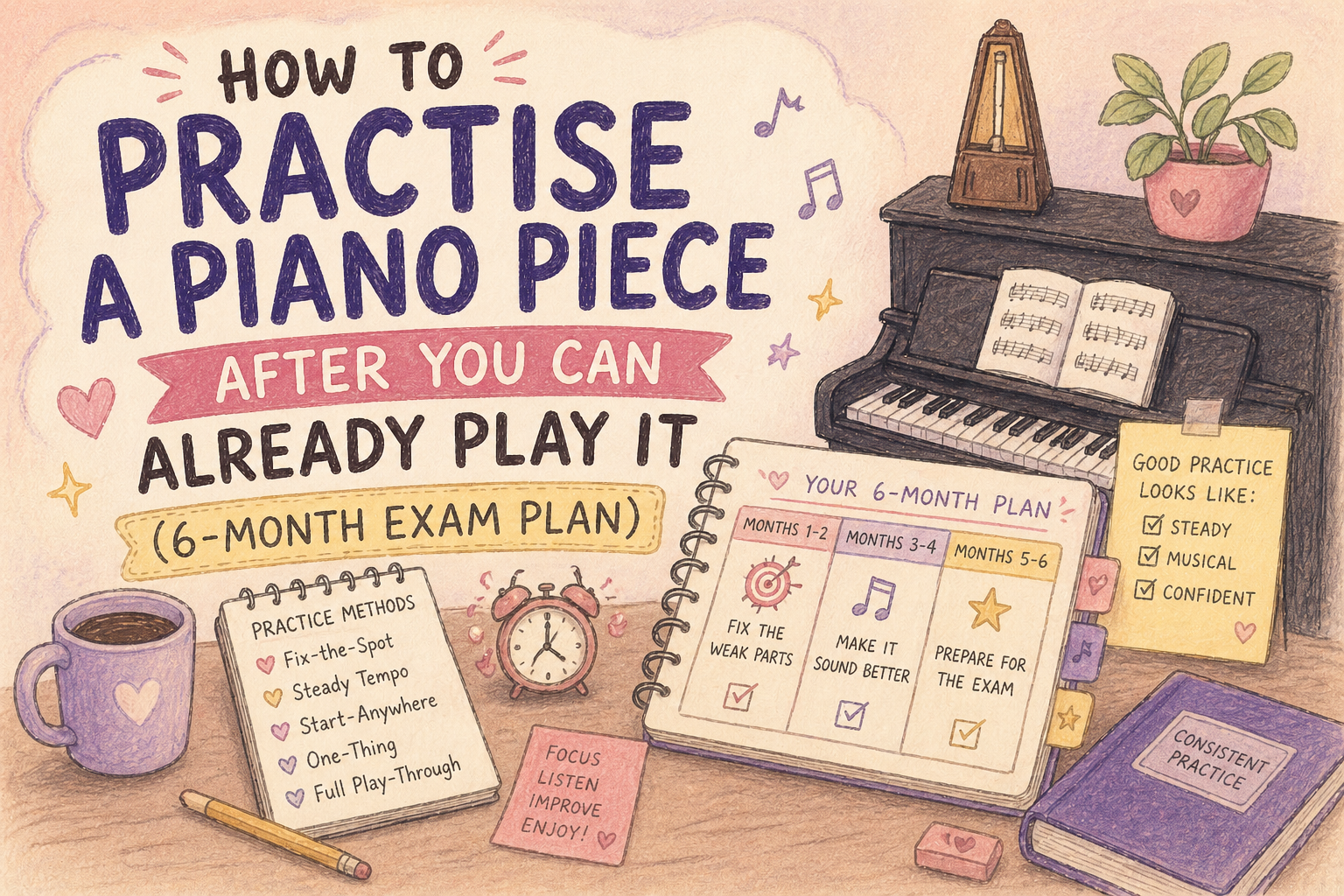
How to Practise a Piano Piece After You Can Already Play It (6-Month Exam Plan)
Introduction
Many students reach a point where they can play their piece from start to finish.
👉 No stopping
👉 Most notes are correct
👉 It sounds “okay”
At this stage, it feels like the piece is done.
But here’s the truth:
Being able to play through a piece does not mean you are ready for the exam.
In fact, this is where the real work begins.
If your exam is 6 months away, what you do now will decide:
Whether your playing becomes confident
Or stays shaky and inconsistent
In this guide, you’ll learn exactly how to continue practising your piece — step by step — in a simple and clear way.
The Common Mistake
Many students think:
👉 “I can play it already, so I just need to repeat it.”
So they:
Play from the beginning every day
Keep going even when mistakes happen
Avoid fixing difficult parts
This causes problems:
❌ Mistakes don’t go away
❌ Weak parts stay weak
❌ The piece starts to feel worse over time
Just playing through is not enough.
The Right Way to Think
You need to change your focus.
👉 Before: “Can I play it?”
👉 Now: “Can I control it?”
This means:
Every note should feel steady
Every section should feel secure
You should know what you are doing, not just rely on memory
Think of it like this:
👉 You are no longer learning the piece
👉 You are improving how well you play it
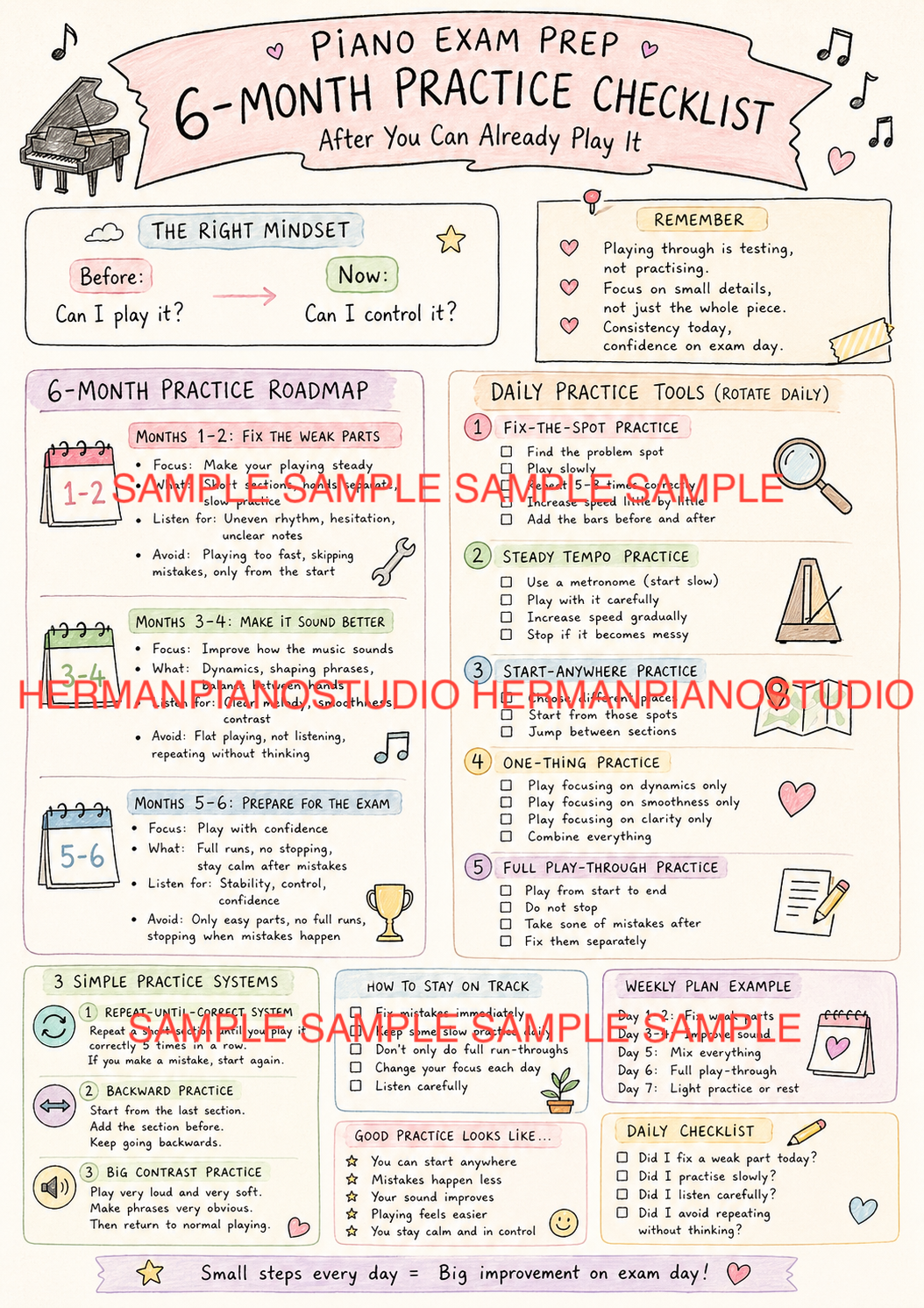
Before we begin, you may also consider getting this printable A4 checklist to put beside your piano while you practice.
Your 6-Month Practice Plan
Months 1–2: Fix the Weak Parts
Main Focus: Make your playing steady and reliable
What to Practise:
Short sections (2–4 bars)
Hands separate when needed
Slow practice
What to Listen For:
Uneven rhythm
Hesitation
Notes that don’t sound clear
Common Mistakes:
Playing too fast
Skipping over mistakes
Only playing from the start
Months 3–4: Make It Sound Better
Main Focus: Improve how the music sounds
What to Practise:
Loud and soft playing
Shaping the music (not flat playing)
Balance between hands
What to Listen For:
Is the melody clear?
Does it sound smooth?
Is there contrast (not all the same)?
Common Mistakes:
Playing everything the same way
Not thinking about sound
Repeating without listening
Months 5–6: Prepare for the Exam
Main Focus: Play with confidence from start to end
What to Practise:
Full play-throughs
Playing without stopping
Staying calm after mistakes
What to Listen For:
Can you keep going smoothly?
Do you feel in control?
Does it sound confident?
Common Mistakes:
Only practising easy parts
Not practising full runs
Stopping when mistakes happen
🎯 Practice Methods You Can Use Daily
1. Fix-the-Spot Practice
What it does: Helps you fix problem areas
Steps:
Find the exact place where you make mistakes
Play it slowly
Repeat 5–8 times correctly
Slowly increase speed
Add the bars before and after
When to use:
Whenever a section feels weak
2. Steady Tempo Practice
What it does: Helps you keep a steady speed
Steps:
Use a metronome at a slow speed
Play carefully with it
Increase speed little by little
Stop if it becomes messy
When to use:
If you rush or slow down too much
3. Start-Anywhere Practice
What it does: Helps you remember your piece better
Steps:
Choose different places in the piece
Practise starting from those spots
Jump between sections
When to use:
If you can only start from the beginning
4. One-Thing Practice
What it does: Improves your sound
Steps:
Play once focusing only on loud and soft
Play again focusing only on smoothness
Play again focusing on clarity
Then combine everything
When to use:
If your playing sounds flat or boring
5. Full Play-Through Practice
What it does: Prepares you for real performance
Steps:
Play from start to end
Do not stop
Take note of mistakes after finishing
Fix them separately
When to use:
2–3 times a week
🧠 3 Simple Practice Systems
1. Repeat-Until-Correct System
Problem: Your playing is not stable
How to do it:
Choose a short section
Repeat until you play it correctly 5 times in a row
If you make a mistake, restart the count
👉 This builds strong control
2. Backward Practice
Problem: You forget parts easily
How to do it:
Start from the last section
Then add the section before
Keep going backwards
👉 This makes your ending strong and secure
3. Big Contrast Practice
Problem: Your playing sounds dull
How to do it:
Make phrases very obvious
Then return to normal playing
👉 This helps you understand expression better
⚠️ Common Pitfalls
Playing the whole piece every day without fixing anything
Ignoring small mistakes
Only playing what feels easy
Going too fast too early
Not listening carefully
🔁 How to Stop Your Piece From Getting Worse
Fix mistakes immediately in small sections
Keep some slow practice every day
Don’t only do full play-throughs
Change what you focus on each day
🎹 How Often to Play the Full Piece
A good balance:
👉 70% fixing sections
👉 30% full play-through
This helps you improve instead of just repeating
✨ How to Keep Your Piece Fresh
Focus on different things each day
Use different practice methods
Don’t just repeat mindlessly
🎯 How to Practise for the Exam
Play for someone (family or teacher)
Record yourself
Do not stop when you play
Practise starting properly
✅ What Good Practice Looks Like
You are improving if:
✔ You can start anywhere
✔ Mistakes happen less often
✔ Your playing feels easier
✔ Your sound improves
✔ You don’t panic after mistakes
📅 Simple Weekly Plan
Day 1–2: Fix weak parts
Day 3–4: Improve sound
Day 5: Mix everything
Day 6: Full play-through
Day 7: Light practice or rest
🧾 Simple Checklist
Ask yourself:
Did I fix a weak part today?
Did I practise slowly?
Did I listen carefully?
Did I avoid repeating without thinking?
Conclusion
Being able to play your piece from start to end is a great step.
But it is not the final goal.
The next 6 months are where you:
Build confidence
Improve control
Make your playing sound better
If you follow a clear plan and practise the right way, your piece will not just be “playable”
👉 It will be strong, confident, and ready for your exam.
If you need further help, do reach out for a trial piano class to manage your learning better. Available for piano students in Singapore only.
