How to Tell If Your Child Is Really Improving in Piano (Beyond Just Passing Exams)
Introduction
Many parents feel relieved when their child passes a piano exam.
👉 “Great, my child is improving!”
But at the same time, there’s often a quiet doubt:
“Why does it still sound a bit rough?”
“Why does my child keep stopping during practice?”
“Are they actually getting better… or just memorising pieces?”
This is a very common concern among parents searching for piano lessons for beginners or working with a piano teacher in Singapore.
The truth is:
👉 Passing exams does not always reflect real musical progress.
In this article, you’ll learn how to accurately tell if your child is improving in piano — using practical signs you can observe at home, even without a musical background.
Why Exams Are Not the Only Measure of Progress
Exams like ABRSM are useful. They provide:
Structure
Goals
Motivation
But they mainly assess:
Short-term preparation
Specific pieces
Performance under pressure
What they don’t fully measure is:
❌ Long-term musical understanding
❌ Consistency in daily practice
❌ Real playing habits
A student can:
👉 Pass an exam… yet still struggle with rhythm, control, or confidence.
That’s why experienced teachers focus on how a student plays and learns, not just the final result.
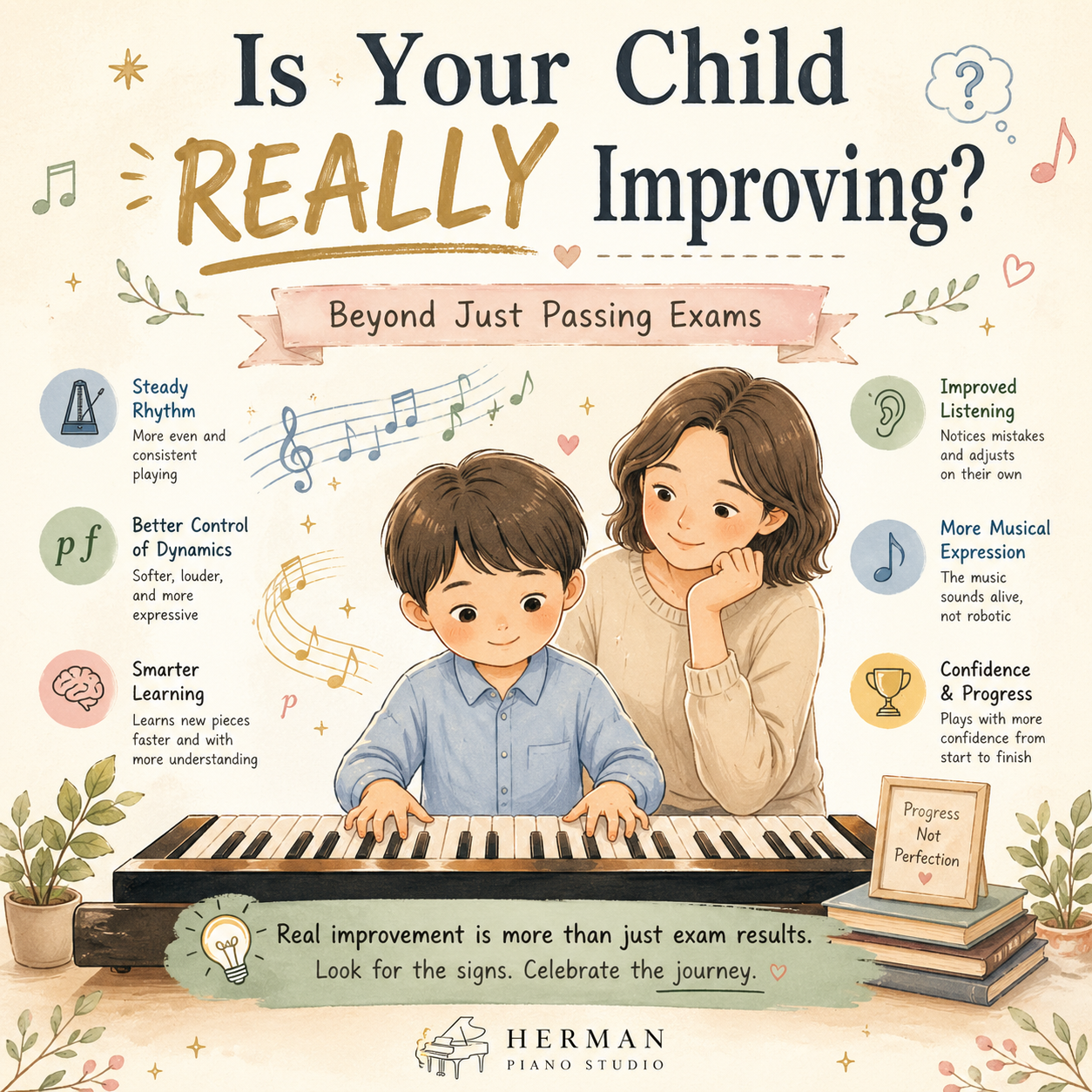
6 Real Signs Your Child Is Improving in Piano
1. More Stable Rhythm (Less Rushing and Slowing Down)
One of the clearest signs of improvement is rhythm control.
What it means:
Your child can keep a steady pulse without speeding up during easy parts or slowing down at difficult sections.
Real-life example:
Previously, your child rushed through familiar bars and stumbled at tricky ones. Now, the tempo feels more even.
What parents can observe:
👉 Does the piece feel “steady” when you listen?
👉 Can they play along with a metronome more comfortably?
This is a key foundation in learning how to learn piano properly.
2. Better Control of Soft and Loud Playing (Dynamics)
Many beginners play everything at one volume.
Improvement shows when your child can:
Play softly when required
Control loud sections without banging
Real-life example:
Instead of everything sounding loud, you start hearing contrast — gentle vs strong.
What parents can observe:
👉 Does the music sound more “expressive” instead of flat?
This is often a major focus in quality piano practice tips taught by experienced teachers.
3. Fewer Stops During Practice
Beginners tend to:
❌ Stop every time they make a mistake
Improving students learn to:
✅ Keep going and recover
Real-life example:
Your child used to restart the whole piece after a mistake. Now, they continue playing and adjust on the spot.
What parents can observe:
👉 Are they playing more smoothly from start to finish?
This shows growing confidence and real musical development.
4. Faster Learning of New Pieces
Improvement isn’t just about playing better — it’s about learning faster.
What it means:
Your child understands patterns, notes, and structure more quickly.
Real-life example:
A piece that used to take 3 weeks now takes 1–2 weeks to reach a decent level.
What parents can observe:
👉 Do new songs feel less overwhelming?
👉 Do they need less help identifying notes?
This is a strong sign that your child is benefiting from structured beginner piano lessons in Singapore
5. Improved Listening Skills
This is one of the most underrated signs of progress.
Improving students begin to:
Notice mistakes on their own
Adjust their playing without being told
Real-life example:
Instead of waiting for correction, your child says:
👉 “That didn’t sound right, let me try again.”
What parents can observe:
👉 Are they becoming more aware of their own playing?
This is a critical step toward independent musicianship.
6. More Musical Expression (Not Just Correct Notes)
At the start, students focus on:
👉 Playing the correct notes
But real progress shows when they begin to:
👉 Shape the music
Real-life example:
You hear phrasing, direction, and emotion — not just mechanical playing.
What parents can observe:
👉 Does the piece feel more “alive” and less robotic?
This is what separates basic playing from true musical growth.
Common Mistakes Parents Make When Judging Progress
Here are some very common misconceptions:
❌ “If my child passed, they must be improving well”
✔️ Exams are just one indicator, not the full picture❌ “If it sounds messy, there is no progress”
✔️ Messiness is often part of learning new skills❌ “More practice time = better results”
✔️ Quality of practice matters more than quantity❌ “Comparing with other children”
✔️ Every student progresses at a different pace
Understanding these helps you better support your child’s journey.
How Parents Can Support Real Improvement
You don’t need to be a musician to help your child improve.
Here are simple, effective ways:
1. Focus on Consistency, Not Perfection
Short, regular practice is more effective than long, irregular sessions.
2. Listen for Improvement, Not Just Mistakes
Instead of saying:
❌ “That was wrong”
Try:
✅ “That sounded more even than before”
3. Encourage Smart Practice Habits
Ask questions like:
“Can you try that section slowly?”
“Can you play it softer this time?”
This reinforces good piano practice tips.
For more structured guidance, you can explore
👉 how to practice piano effectively
4. Work With the Right Teacher
A good teacher doesn’t just prepare students for exams.
They:
Build strong fundamentals
Develop musical understanding
Guide long-term growth
If you are looking for structured, personalised guidance, consider exploring
👉 piano lessons near Tampines, Singapore.
Conclusion
It’s completely natural for parents to look at exam results as a measure of success.
But real piano improvement goes far beyond:
❌ Just passing exams
Instead, look for:
✅ Better rhythm
✅ Improved control
✅ More confidence
✅ Stronger listening skills
✅ Musical expression
These are the signs that your child is not just learning pieces…
👉 but truly learning music.
With the right guidance, consistent practice, and supportive environment, your child can develop skills that last far beyond any exam.
