How To Recognise Baroque Keyboard Music? 6 Tips for ABRSM Aural Exam (Grade 5 - 8)
Baroque Keyboard Music: A Student’s Guide
The Baroque period lasted from about 1600 to 1750. During this time, composers developed many of the musical ideas that shaped later Western classical music. Major and minor keys became firmly established, instrumental music grew in importance, and composers explored counterpoint in remarkable detail.
Keyboard music was central to these developments. It was written for instruments including the harpsichord, clavichord and organ. Baroque keyboard works range from elegant dances to brilliant sonatas and complex fugues.
Here are 6 Tips to listen for: Melody, ornamentation, harmony and tonality, texture, rhythm, common forms and structure.
Melody
Baroque melodies are often built from short musical ideas called motifs. A motif may be repeated, altered or passed between different parts.
Students might hear:
Long, flowing melodic lines with few obvious pauses.
A short motif developed throughout a movement.
Sequences, in which a musical idea is repeated at successively higher or lower pitches.
Melodies shaped from scales, broken chords and decorative patterns.
Different melodic lines sounding at the same time.
In the opening Prelude in C major from Bach’s The Well-Tempered Clavier, Book I, patterns of broken chords create a continuous flow rather than a single tune with accompaniment.
2.Ornamentation
Ornaments are decorative notes added to a melody. They were an important part of Baroque expression, not simply optional decoration.
Common ornaments include:
Trills – rapid alternation between a written note and the note above.
Mordents – quick movement from the main note to a neighbouring note and back.
Turns – a small pattern circling around the written note.
Appoggiaturas – expressive, usually dissonant notes that lean onto the main note.
Here is an example. Notice how ornaments are used in the piece.
Students may hear notes that sparkle, delay a resolution or make a repeated phrase more expressive. Performers were often expected to add ornaments, especially when repeats were played.
Ornament symbols and their meanings varied between composers and countries. In many Baroque styles, a trill commonly begins on the note above the written note, although this is not a universal rule.
3.Harmony and Tonality
The Baroque period saw the growth of functional harmony: chords were heard as having different roles within a key.
Typical features include:
Clear major and minor keys.
Frequent movement between the tonic and dominant.
Modulation, or movement, to related keys.
Strong cadences at important structural points.
Suspensions, where a note is held over to create dissonance before resolving.
Pedal notes, especially on the organ, where a long or repeated bass note supports changing harmonies.
Harmonic sequences, often moving through a chain of related chords.
A movement in a major key may modulate to the dominant near the middle, then return to the tonic before the end. Minor-key pieces often visit the relative major.
4.Texture
Much Baroque keyboard music is polyphonic or contrapuntal. This means that two or more independent melodic lines are combined.
Students might hear:
A subject imitated by several voices.
Melodic lines entering one after another.
Parts that seem to “converse” with each other.
A bass line that is almost as active as the upper parts.
Contrasts between contrapuntal writing and simpler chordal passages.
A fugue is a clear example. Its main theme, called the subject, enters in different voices and is then developed. However, not all Baroque music is densely contrapuntal. Many dances use a more melody-led texture supported by chords.
5.Rhythm
Baroque keyboard music often has a strong rhythmic drive. Once a rhythmic pattern begins, it may continue for much of the movement.
Common features include:
A steady pulse and continuous movement.
Repeated rhythmic patterns.
Running semiquavers in fast movements.
Dotted rhythms, sometimes creating a grand or ceremonial character.
Rhythms associated with particular dances.
Occasional changes of tempo and metre between sections.
A gigue commonly uses compound metre, such as 6/8 or 12/8, and has a lively, energetic rhythm. A sarabande is usually slower, in triple metre, and often gives emphasis to the second beat.
Common Forms and Structures
Baroque composers used several recognisable forms:
Binary form (AB): two sections, normally repeated. The first often moves away from the tonic, while the second returns to it.
Dance suite: a collection of contrasting dances. The usual core is allemande, courante, sarabande and gigue.
Prelude and fugue: a freer introductory piece followed by a carefully organised contrapuntal movement.
Theme and variations: a theme is repeated with changes to its rhythm, melody, texture or decoration.
Toccata: a free, brilliant piece designed to display the performer’s technique.
Chorale prelude: an organ work based on a Lutheran hymn tune.
Chaconne or passacaglia: variations built over a repeating bass line or harmonic pattern.
Single-movement sonata: especially associated with Domenico Scarlatti and often written in binary form.
Keyboard Instruments
The modern piano was not the main keyboard instrument of the Baroque period.
Harpsichord: its strings are plucked. It produces a bright, clear sound but cannot make a smooth crescendo simply through stronger finger pressure.
Clavichord: small and quiet, with strings struck by metal tangents. It allows subtle dynamic control and even a gentle vibrato-like effect called Bebung.
Organ: produces sound by sending air through pipes. Different stops create contrasting tone colours, while the pedals can play the bass line.
Early piano: invented around 1700, but it only became widely important after the Baroque period.
6.Dynamics, Articulation and Phrasing
Baroque scores often contain fewer performance markings than later music. Performers were expected to understand the style and shape the music themselves.
Students might notice:
Terraced dynamics – fairly sudden changes between loud and soft.
Dynamic contrast created by changing manuals or registration.
Clear articulation between notes rather than continuous heavy legato.
Phrases shaped through timing, articulation and harmonic direction.
Cadences that act like punctuation marks.
Stronger and weaker beats suggested by metre and dance character.
Terraced dynamics are common, but not every Baroque phrase should sound mechanically loud or soft. The clavichord and organ, for example, offer different expressive possibilities from the harpsichord.
Typical Performance Practices
A convincing Baroque performance usually combines clarity with rhythmic energy.
Performers often:
Add or vary ornaments, particularly in repeated sections.
Observe repeats and make the second hearing slightly different.
Keep contrapuntal lines clear and balanced.
Use articulation to show motifs, dance rhythms and separate voices.
Choose suitable harpsichord or organ registrations.
Play written notes unevenly in certain French styles, rather like a gentle long–short pattern.
Use small amounts of rhythmic freedom at expressive points while preserving the underlying pulse.
Improvise introductions, links or embellishments when appropriate.
Historical pitch and tuning were not completely standardised. Modern performers therefore make informed choices rather than following one universal set of rules.
Important Composers and Representative Works
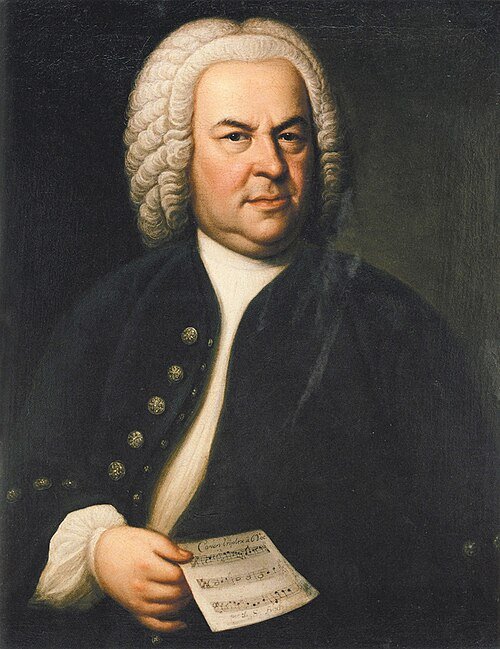
J.S.Bach
Johann Sebastian Bach:The Well-Tempered Clavier, Goldberg Variations, English and French Suites, and numerous organ preludes and fugues.
George Frideric Handel: keyboard suites, including the Suite in E major containing The Harmonious Blacksmith variations.
Domenico Scarlatti: over 500 keyboard sonatas, including the energetic Sonata in D minor, K.141.
François Couperin:Pièces de clavecin, noted for elegant French ornamentation and character pieces.
Jean-Philippe Rameau: harpsichord collections containing vivid works such as La poule.
Girolamo Frescobaldi: influential toccatas and other early Baroque keyboard works.
Henry Purcell: suites, grounds and short pieces for harpsichord and organ.
Quick Recap
The Baroque period lasted approximately 1600–1750.
Important instruments included the harpsichord, clavichord and organ.
Melodies often use motifs, sequences and flowing patterns.
Ornamentation is an essential part of the style.
Major and minor tonality, clear cadences and functional harmony are typical.
Contrapuntal textures and independent melodic lines are common.
Rhythms are often steady, energetic and influenced by dance.
Important forms include binary form, suites, fugues, variations and toccatas.
Dynamics depend greatly on the instrument; sudden contrasts are often heard.
Clear articulation, thoughtful ornamentation and strong rhythmic character help bring Baroque keyboard music to life.
Located in Tampines:
Looking for a patient piano teacher in Tampines, Singapore? Explore my personalised piano lessons for children and adults.
[Member’s Only Content]
I have also provided a 7 Page PDF Checklist to help students recognise Baroque Music for ABRSM Aural (G5-G8). It is Available for download in my Member’s Page
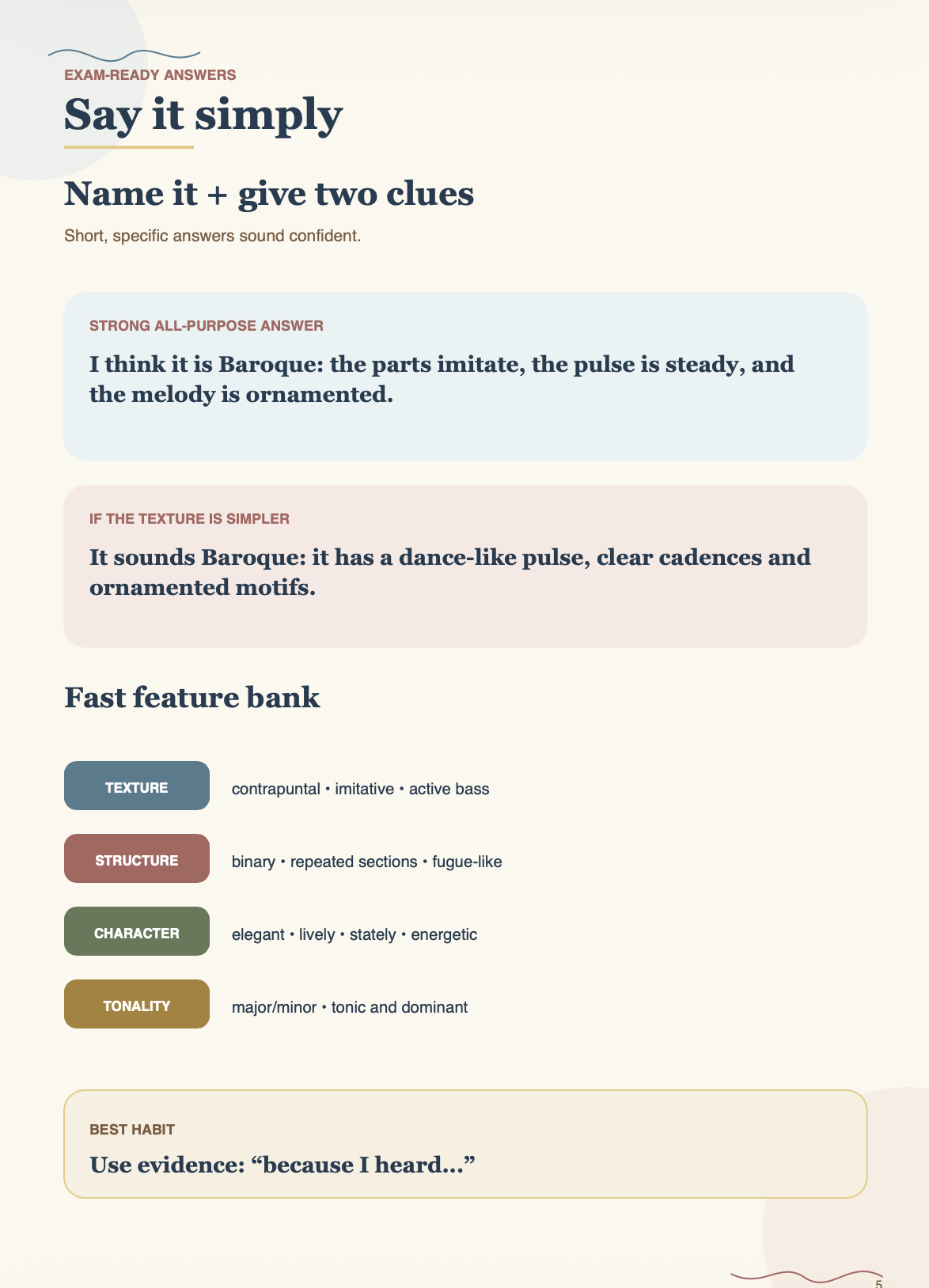
Answer With Confidence
PDF also helps students to answer with confidence.
