Introduction
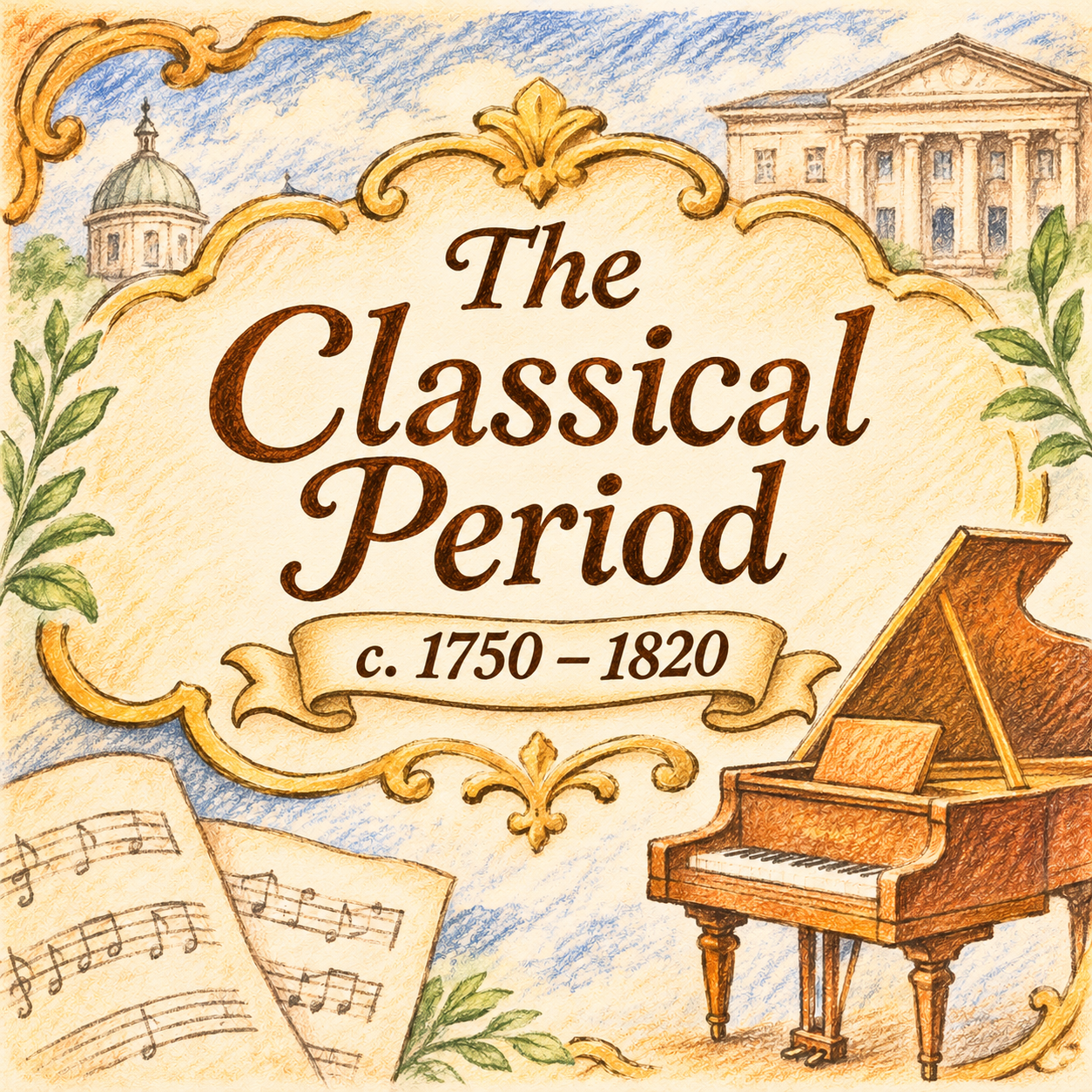
The Classical period lasted from about 1750 to 1820, although musical periods never begin or end on an exact date. During this time, composers valued clarity, balance and proportion. Melodies became more clearly phrased, textures were often lighter than in Baroque music, and musical structures grew increasingly important.
Keyboard music changed significantly as the fortepiano gradually replaced the harpsichord. Composers could now use changes of touch to create crescendos, accents and contrasts of tone. Classical keyboard works range from graceful miniatures to dramatic sonatas and concertos.
1.Melody
Classical melodies are often clear, balanced and easy to recognise. They may be organised into regular phrases, rather like musical sentences.
Students might hear:
Short, memorable melodic ideas.
Balanced phrases, often four or eight bars long.
A question-and-answer pattern known as antecedent and consequent phrasing.
Repetition with small changes to rhythm, pitch or articulation.
Contrasting themes within the same movement.
Melodies decorated with scales, arpeggios and ornaments.
Clear pauses or cadences between phrases.
In the opening of Mozart’s Sonata in C major, K.545, the melody is graceful and symmetrical. Short phrases are supported by a simple accompaniment, making the structure easy to follow.
Classical melodies are not always calm or predictable. Beethoven often breaks regular phrases into smaller motifs, repeats individual notes or interrupts the flow with sudden accents and pauses.
2.Ornamentation
Ornaments remained important during the Classical period, although they were generally used more selectively than in Baroque music. They could decorate a melody, emphasise an expressive note or lead smoothly into a cadence.
Common ornaments include:
Trills – rapid alternation between a written note and the note above.
Turns – a four-note figure moving around the written note.
Mordents – a quick movement between the main note and a neighbouring note.
Appoggiaturas – expressive notes that create tension before resolving.
Grace notes – small decorative notes played just before or on the beat.
The correct performance of an ornament depends on the composer, date and musical context. A trill may begin on the upper note in some earlier Classical works, while later examples may begin on the written note.
Ornaments should sound like part of the phrase rather than separate technical exercises. Their speed and character should suit the tempo: a trill in a slow movement may be expressive and measured, while one in a lively finale may be light and brilliant.
3.Harmony and Tonality
Classical music usually has a clear tonal plan. Most pieces are firmly based in a major or minor key, with changes of key helping to organise the structure.
Typical features include:
Frequent use of tonic, dominant and subdominant chords.
Clear cadences at the ends of phrases.
Modulation to closely related keys.
Dominant sevenths and diminished seventh chords.
Alberti bass, in which the notes of a chord are repeated in a low–high–middle–high pattern.
Harmonic tension followed by a clear resolution.
Occasional chromatic notes for colour or expression.
In a major-key sonata-form movement, the music commonly moves from the tonic to the dominant during the exposition. In a minor-key movement, it may move to the relative major. Later, the recapitulation brings the main themes back in the tonic key.
Harmony became more adventurous towards the end of the period. Beethoven used unexpected modulations, dramatic diminished chords and sudden shifts between major and minor to increase tension.
4.Texture
Classical keyboard music is often homophonic, meaning that a main melody is supported by an accompaniment. This usually makes the melody easier to identify than in densely contrapuntal Baroque music.
Students might hear:
A melody in the right hand with chords in the left hand.
Alberti-bass or broken-chord accompaniment.
Repeated chords beneath a singing melody.
Dialogue between the upper and lower parts.
A melody moving from one hand to the other.
Short contrapuntal or imitative passages.
Chordal textures used for strong or dramatic moments.
Although melody-and-accompaniment writing is common, Classical composers still studied counterpoint. Haydn, Mozart and Beethoven sometimes introduced imitation or fugue-like writing, particularly in development sections and finales.
Balance is important in performance. The accompaniment should support the melody without overpowering it, but inner parts and bass lines may occasionally need to come forward when they contain important material.
5.Rhythm
Classical music often has a clear pulse and regular metre, but composers use changes in rhythm to create contrast, humour and drama.
Common features include:
Clearly defined rhythmic patterns.
Regular phrase lengths.
Contrasts between long and short note values.
Alberti-bass and other repeated accompaniment figures.
Dotted rhythms in grand or energetic passages.
Syncopation, where notes are accented between the main beats.
Sudden rests or pauses that interrupt the expected flow.
Changes in rhythmic activity between themes.
A first theme might be energetic and rhythmically active, while the second is smoother and more lyrical. In a minuet, the triple metre usually creates an elegant dance character. A finale may use rapid quavers or semiquavers to produce excitement.
Beethoven often uses a tiny rhythmic motif to unify an entire movement. Repeated off-beat accents, unexpected silences and strong contrasts can make the music sound restless or dramatic.
Common Forms and Structures
Classical composers used clear structures to organise and develop their musical ideas:
Binary form (AB): two sections, usually repeated. The first moves away from the tonic, while the second returns to it.
Ternary form (ABA): an opening section, a contrasting middle section and a return of the opening.
Sonata form: normally includes an exposition, development and recapitulation. The exposition presents contrasting themes, the development explores them in different keys, and the recapitulation returns them in the tonic.
Rondo form: a principal theme returns between contrasting episodes. Common patterns include ABACA and ABACABA.
Theme and variations: a theme is repeated with changes to its melody, harmony, rhythm, texture or decoration.
Minuet and trio: two dances in triple metre, usually organised as minuet–trio–minuet.
Scherzo and trio: a faster, more energetic development of the minuet-and-trio design.
Multi-movement sonata: often contains a fast first movement, a slower movement and a lively finale. Some sonatas include a minuet or scherzo as an additional movement. Two movement sonatas are less common.
Concerto: a work for solo instrument and orchestra, often in three movements. It contrasts the soloist’s material with orchestral passages.
A sonata is a complete work containing multi-movements, while sonata form describes the internal structure of a single movement. A movement in sonata form can appear in a sonata, symphony, quartet or concerto.
Keyboard Instruments
The Classical period saw the piano become the leading domestic and concert keyboard instrument.
Fortepiano: an early form of the piano. Its hammers strike the strings, allowing performers to control dynamics through touch. It had a lighter tone and smaller range than the modern piano.
Harpsichord: still used during the early Classical period, especially for accompaniment, but it gradually became less fashionable.
Clavichord: valued for private practice and its sensitive touch, although it was too quiet for large concert spaces.
Modern piano: more powerful and sustained than a Classical fortepiano. Modern performers must take care not to make light Classical textures sound too heavy.
Organ: continued to be used in churches, although it was less central to Classical keyboard music than it had been during the Baroque period.
The fortepiano developed rapidly. Its range expanded, its mechanisms became stronger, and pedals or knee levers allowed performers to sustain notes or change the tone.
6.Dynamics, Articulation and Phrasing
Classical composers wrote more detailed dynamics and articulation marks than many Baroque composers. The piano made gradual and sudden changes of volume especially effective.
Students might notice:
Contrasts between piano and forte.
Crescendos and diminuendos.
Sudden accents such as sforzando.
Short slurs showing the shape of a motif or phrase.
Contrasts between legato and staccato.
Cadences acting like punctuation.
Strong and weak beats shaped according to the metre.
Echo effects, where a phrase is repeated more softly.
Slurs in Classical music often indicate both articulation and phrasing. The beginning of a slur may receive a gentle emphasis, with the final note released lightly. However, this should not become an exaggerated accent every time.
Dynamics should follow the direction of the phrase. A crescendo may lead towards a cadence, a harmonic climax or the highest note of a melody. Sudden contrasts should be clear without producing a harsh tone.
Typical Performance Practices
A convincing Classical performance combines elegance and clarity with a wide range of character.
Performers often:
Shape balanced phrases like spoken sentences.
Keep accompaniment patterns lighter than the melody.
Observe slurs, staccatos and rests carefully.
Use a controlled, transparent tone.
Make repeated sections more interesting through subtle changes of dynamics or expression.
Choose tempos that allow both clarity and forward movement.
Use rubato sparingly so that the basic pulse remains secure.
Pedal lightly and change it with the harmony.
Highlight contrasts between themes and sections.
Treat ornaments as expressive parts of the melody.
The sustaining pedal should be used with particular care. Too much pedal can blur rests, articulation and harmonic changes. A modern piano has greater resonance than a fortepiano, so performers may need less pedal than they would use in Romantic music.
Not all Classical music should sound delicate. Mozart can be operatic and dramatic, Haydn can be witty and surprising, and Beethoven often requires power, urgency and strong contrasts.
Important Composers and Representative Works
Joseph Haydn: more than 50 keyboard sonatas, including the Sonata in E-flat major, Hob. XVI:52. His music often contains humour, unexpected pauses and inventive development.
Wolfgang Amadeus Mozart: piano sonatas, variations and concertos, including the Sonata in C major, K.545, and Sonata in A major, K.331.
Ludwig van Beethoven: 32 piano sonatas, including the Pathétique, Moonlight and Waldstein. His music connects the Classical and Romantic periods.
Muzio Clementi: influential sonatas and sonatinas that explore the clarity, brilliance and technical possibilities of the piano.
Johann Christian Bach: keyboard sonatas and concertos in a graceful, melody-led style that influenced Mozart.
Carl Philipp Emanuel Bach: expressive keyboard works featuring sudden contrasts and unexpected changes, helping to connect Baroque and Classical styles.
Jan Ladislav Dussek: piano sonatas and concertos that use a broad keyboard range and anticipate aspects of Romantic piano writing.
Marianna Martines: sonatas and concertos combining elegant Classical melodies with skilled contrapuntal writing.
Quick Recap
The Classical period lasted approximately 1750–1820.
Clarity, balance, contrast and proportion are central features of the style.
Melodies are often memorable and organised into balanced phrases.
Harmony is tonal, with clear cadences and modulation to related keys.
Homophonic melody-and-accompaniment textures are common.
Alberti bass and other broken-chord patterns frequently appear.
Important forms include sonata form, rondo, ternary form, variations and minuet and trio.
The fortepiano allowed performers to create dynamic contrasts through touch.
Articulation, phrasing and carefully controlled pedal are essential in performance.
Haydn, Mozart and Beethoven are the period’s best-known keyboard composers, but Clementi and members of the Bach family were also highly influential.
Located in Tampines:
Looking for a patient piano teacher in Tampines, Singapore? Explore my personalised piano lessons for children and adults.
