Introduction
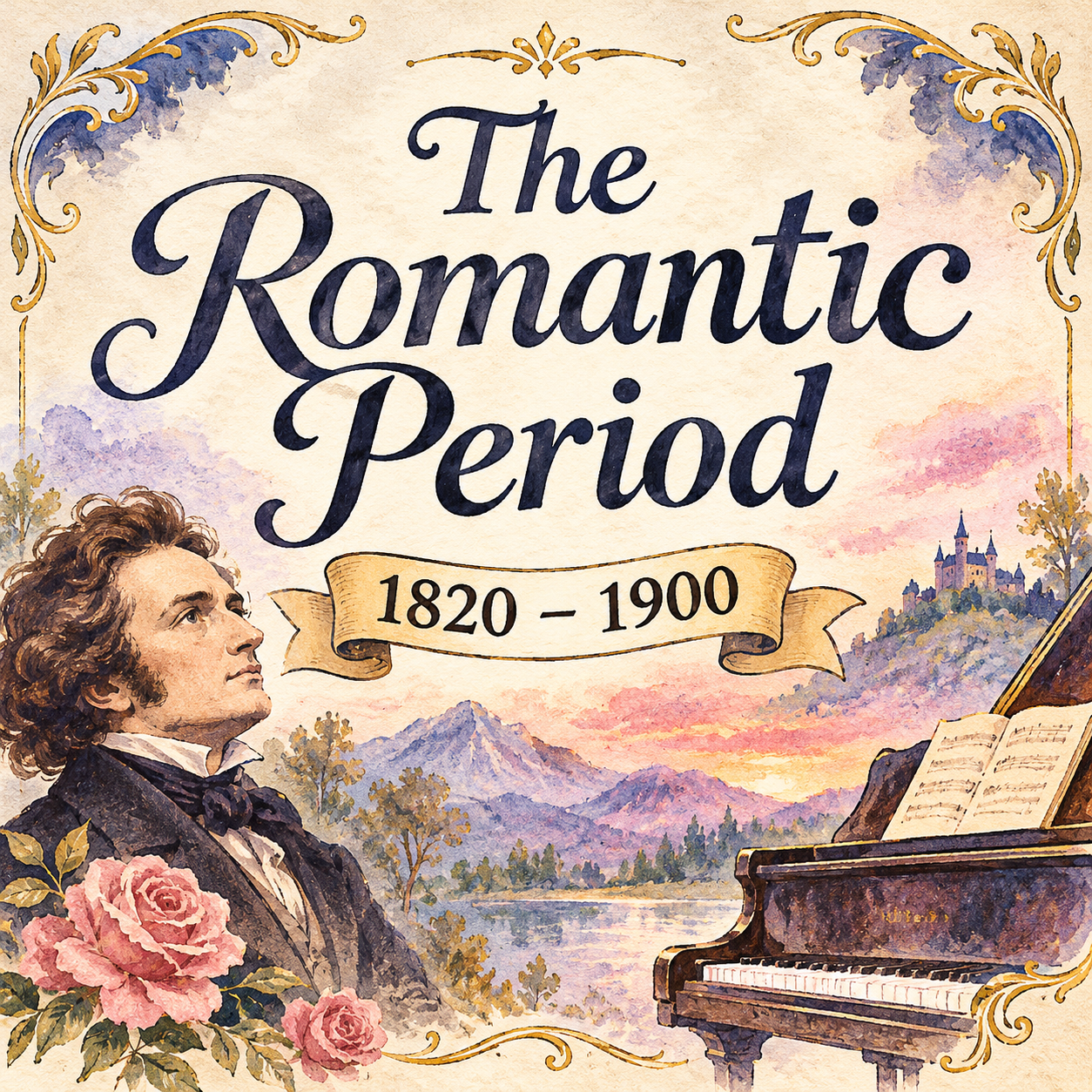
The Romantic period lasted approximately from 1820 to 1900, although musical periods never begin or end on an exact date. Romantic composers placed increasing importance on imagination, individuality and emotional expression. Their music can suggest intimate feelings, dramatic stories, distant places, nature, poetry or national identity.
The piano was the leading keyboard instrument of the Romantic period and became increasingly central to concert, domestic and teaching life. Improvements to its range, power and sustaining mechanism allowed composers to write singing melodies, enormous chords, rapid runs and rich layers of sound. Romantic keyboard music ranges from short character pieces suitable for the home to technically demanding concert works.
1.Melody
Romantic melodies are often lyrical and expressive. Composers frequently tried to make the piano imitate the sustained, flexible qualities of the human voice.
Students might hear:
Long, singing melodic lines.
Phrases of irregular or changing length.
Melodies that rise towards an expressive high point.
Appoggiaturas and suspensions that create tension before resolving.
Repeated motifs that change in pitch, harmony or character.
Chromatic notes outside the main key.
Melodies doubled in octaves or supported by inner voices.
A melody passing between the hands or appearing within a chordal texture.
In Chopin’s nocturnes, the right hand often plays an ornamented, song-like melody above a flowing left-hand accompaniment. The melody should sound natural and flexible, rather than like a series of separate notes.
Schumann often builds pieces from short motifs. These ideas may return in a different register, key or mood, helping the music suggest changing emotions or characters.
A Romantic melody does not always need to be slow or gentle. In the music of Liszt, Brahms and Rachmaninoff, melodies can be heroic, passionate or powerful. Even then, the performer should identify the main line and shape it clearly.
2.Ornamentation
Romantic composers used ornaments to make melodies more expressive and to create a sense of freedom or improvisation. Unlike some earlier music, Romantic composers used both conventional ornament signs and fully written-out decorative passages, often controlling elaborate decoration more precisely.
Common ornaments and decorative features include:
Trills – rapid alternation between two neighbouring notes.
Turns – a figure moving above and below the main note.
Mordents – a quick movement between a written note and a neighbouring note.
Grace notes – decorative notes played just before or with the main note.
Appoggiaturas – expressive, often dissonant notes that resolve by step.
Arpeggiated chords – chords whose notes are spread rather than played together.
Rapid scales, chromatic runs and fioritura, or elaborate melodic decoration.
In a lyrical piece, ornaments should belong to the melodic line rather than interrupt it. Their timing may be flexible, but they must still lead naturally towards the next important note.
Chopin’s ornaments are often influenced by operatic singing. A long trill may begin calmly and increase in intensity, while a group of small notes may be played freely before resolving onto a melodic note. The precise approach depends on the musical context.
Technical control is essential. An ornament should remain light and even, but its character should suit the piece. A delicate turn in a nocturne will sound very different from a brilliant trill in a concert étude.
3.Harmony and Tonality
Most Romantic music remains tonal, with a recognisable major or minor key, but its harmony is usually more colourful and chromatic than Classical music.
Typical features include:
Frequent use of seventh and ninth chords.
Diminished seventh chords for tension or drama.
Chromatic notes that enrich the harmony.
Suspensions and appoggiaturas that delay resolution.
Movement between major and minor.
Modulation to more distant keys.
Enharmonic modulation, in which a note or chord is reinterpreted to lead into another key.
Pedal notes held or repeated beneath changing harmonies.
Harmonic sequences that build intensity.
Modal harmony or scales influenced by folk music.
Romantic composers sometimes delay a cadence or avoid the resolution that listeners expect. This can make the music sound restless, longing or uncertain.
In a character piece, the middle section may move into a contrasting key before the opening material returns. In larger works, composers may travel through several distant keys while using a recurring motif to keep the music connected.
Chopin often colours a simple melodic line with chromatic inner parts. Liszt uses unexpected chord changes and enharmonic shifts to transform one idea into another. Brahms may combine rich harmony with carefully controlled bass lines and inner voices.
Students do not need to label every complex chord before they can perform the music effectively. However, recognising cadences, sequences, modulations and moments of dissonance will help them shape the musical direction.
4.Texture
Romantic piano textures range from a single unaccompanied melody to massive chords covering most of the keyboard.
Students might encounter:
A melody with broken-chord accompaniment.
Wide-spaced arpeggios extending across several octaves.
Chordal writing with the melody at the top.
A melody hidden in a middle voice.
Octave melodies or octave bass lines.
Several layers requiring different tone colours.
Contrapuntal passages with two or more independent parts.
Tremolos and repeated chords creating orchestral effects.
Accompaniment patterns that imitate a guitar, harp or orchestra.
Balance is one of the main challenges in Romantic music. A flowing accompaniment may contain many notes, but it should not cover the melody. The hand playing the melody may also contain accompanying notes, so the performer must voice the top note more strongly while keeping the others quieter.
Inner voices are sometimes important. A note held by a thumb, for example, may form a counter-melody beneath the main line. Students should decide which part is most important at each moment instead of playing every note with equal weight.
5.Rhythm
Romantic composers use rhythm to create movement, tension and flexibility. The written metre may remain regular while the melody seems to move freely above it.
Common features include:
Rubato, or expressive flexibility of tempo.
Syncopation and off-beat accents.
Dotted rhythms in dramatic or march-like music.
Cross-rhythms such as two notes against three.
Rapid changes between long and short note values.
Hemiola, where the expected grouping of beats temporarily changes.
Dance rhythms from waltzes, mazurkas, polonaises and other national styles.
Accompaniment patterns that continue beneath a freer melody.
Sudden pauses or changes of tempo.
Rubato does not mean that the pulse disappears. In one type of rubato, especially associated with Chopin, the accompaniment remains relatively steady while the melody moves freely. Elsewhere, both hands may change tempo together.
Different dances have distinctive rhythmic characters. A waltz normally has three beats in a bar, with a bass note followed by two accompanying chords. A mazurka is also in triple metre, but may place unusual emphasis on the second or third beat.
Brahms frequently uses cross-rhythms and displaced accents, making the metre feel temporarily uncertain. Careful counting is essential before any expressive rhythmic freedom is added.
Common Forms and Structures
Romantic composers continued to use Classical forms while also developing shorter, more personal types of composition:
Binary form (AB): two contrasting sections, often with each section repeated.
Ternary form (ABA): an opening section, a contrasting middle and a return of the opening.
Rondo form: a principal theme returns between contrasting episodes.
Sonata form: an exposition, development and recapitulation, sometimes treated more freely than in Classical music.
Theme and variations: a theme returns with changes to its melody, harmony, rhythm, texture or character.
Character piece: a short composition expressing a particular mood, scene or idea.
Song without words: a lyrical piano piece resembling a song but containing no text.
Nocturne: a reflective, often song-like piece associated with the night.
Prelude: a short piece that may establish a single mood or explore a particular musical idea.
Étude: a study designed to develop a technical skill, sometimes also written for concert performance.
Impromptu: a composed piano piece whose title suggests spontaneity or improvisation, although its structure may be carefully organised.
Ballade or rhapsody: a freer composition that may suggest a dramatic story.
Romantic dances: including the waltz, mazurka and polonaise.
Short character pieces became especially important because they could express one concentrated mood. Collections such as Schumann’s Album for the Young and Tchaikovsky’s Album for the Young also provided imaginative music for developing pianists.
Larger forms did not disappear. Schubert, Chopin, Schumann, Liszt and Brahms all composed substantial sonatas, while variation form remained an important way of combining structural control with imagination.
Keyboard Instruments
The piano changed greatly during the Romantic period:
Expanded range: the keyboard gradually grew to seven octaves or more.
Iron frame: stronger construction allowed the strings to be placed under greater tension, producing a more powerful sound.
Felt-covered hammers: these helped create a fuller and warmer tone.
Improved action: faster repetition made brilliant passagework and repeated notes more practical.
Sustaining pedal: dampers could be lifted from the strings, allowing notes to resonate together.
Una corda pedal: this softened the tone and changed its colour.
Upright piano: a more compact instrument that became common in middle-class homes.
Organ and harmonium: these remained important in churches, homes and some concert music, although the piano dominated solo keyboard composition.
The modern concert grand is generally more powerful and resonant than the pianos known by early Romantic composers. Performers should use this power thoughtfully. Thick chords may require considerable weight, but delicate passages and inner textures must remain clear.
Different composers knew different types of piano. Schubert’s instrument was lighter than the later pianos used by Brahms. Therefore, the same touch and pedalling will not suit every Romantic work.
6.Dynamics, Articulation and Phrasing
Romantic scores contain detailed instructions about volume, touch, tempo and expression. These markings help reveal the emotional shape of the music.
Students might notice:
A wide dynamic range, from ppp to fff.
Long crescendos and diminuendos.
Sudden contrasts such as subito piano.
Accents, sforzandos and tenuto marks.
Directions such as cantabile (“in a singing style”), dolce (“sweetly”) and espressivo (“expressively”).
Changes of tempo, including ritardando, rallentando and accelerando.
Long phrase marks crossing bar lines.
Contrasts between legato, staccato and portato.
Detailed pedal markings.
Dynamics should follow the structure of the phrase. A crescendo may lead towards a high note, dissonance, harmonic change or important arrival point. A diminuendo does not always mean that the music loses energy; it may create expectation before the next phrase.
Long slurs often indicate the broad direction of a phrase rather than requiring an unbroken physical legato. Pianists can create the impression of a continuous line through careful listening, finger control and pedal.
Small hairpins may show the rise and fall of a short melodic idea. They should be noticeable without becoming exaggerated.
Typical Performance Practices
A convincing Romantic performance combines emotional expression with careful control.
Performers often:
Produce a warm, singing tone in melodic passages.
Shape long phrases towards and away from their high points.
Keep accompaniment figures quieter than the melody.
Bring out important bass lines and inner voices.
Use rubato without losing the underlying pulse.
Pedal according to the harmony and clarity of the texture.
Observe detailed dynamic and expression markings.
Build climaxes gradually rather than playing loudly too soon.
Distinguish between lyrical, dramatic, playful and dance-like characters.
Use flexibility without distorting the musical structure.
Pedalling is especially important. The sustaining pedal can connect notes, enrich the tone and create atmosphere, but too much pedal will blur harmonic changes. Students should listen carefully and change the pedal when the harmony changes, adjusting for the instrument and room.
Half-pedalling or brief touches of pedal may help clarify dense passages. In some pieces, finger legato should be learned before pedal is added so that the pedal enhances the phrasing instead of hiding uneven playing.
Romantic music should not automatically be slow, heavy or sentimental. Mendelssohn often requires lightness and precision, Chopin’s dance music needs rhythmic character, and Brahms combines warmth with strong structural control.
Important Composers and Representative Works
Franz Schubert: impromptus, dances, character pieces and piano sonatas. His music is known for lyrical melody and unexpected harmonic changes.
Felix Mendelssohn:Songs without Words, rondos and larger concert works combining elegance, lyricism and brilliant technique.
Fanny Mendelssohn Hensel: lyrical piano pieces, including Das Jahr, a cycle inspired by the months of the year.
Frédéric Chopin: nocturnes, preludes, études, waltzes, mazurkas, polonaises and ballades. His writing transformed the expressive and technical possibilities of the piano.
Robert Schumann: imaginative collections such as Kinderszenen, Album for the Young and Carnaval, often inspired by literature, characters or personal ideas.
Clara Schumann: character pieces, variations and technically demanding concert works featuring lyrical melodies and rich textures.
Franz Liszt: études, rhapsodies, transcriptions and poetic works that use the piano to imitate orchestral colours and display great virtuosity.
Johannes Brahms: intermezzi, rhapsodies, variations and sonatas combining Romantic warmth with counterpoint and carefully organised structures.
Edvard Grieg:Lyric Pieces and works influenced by Norwegian folk music, with distinctive rhythms, harmonies and images of nature.
Pyotr Ilyich Tchaikovsky: character pieces including The Seasons and Album for the Young, known for memorable melodies and clear changes of mood.
Quick Recap
The Romantic period lasted approximately 1820–1900.
Imagination, individuality and emotional expression are central features of the style.
Melodies are often long, lyrical and song-like.
Harmony is tonal but may include extensive chromaticism and distant modulations.
Piano textures range from delicate single lines to rich chords and orchestral effects.
Rubato creates expressive flexibility while preserving an underlying pulse.
Popular forms include nocturnes, preludes, études, impromptus, character pieces and dances.
The piano developed a wider range, stronger frame and more powerful, sustained tone.
Voicing, balance, phrase direction and thoughtful pedalling are essential in performance.
Schubert, Chopin, Schumann, Liszt and Brahms are major Romantic keyboard composers, alongside important figures such as Fanny Mendelssohn Hensel and Clara Schumann.
Located in Tampines:
Looking for a patient piano teacher in Tampines, Singapore? Explore my personalised piano lessons for children and adults.
