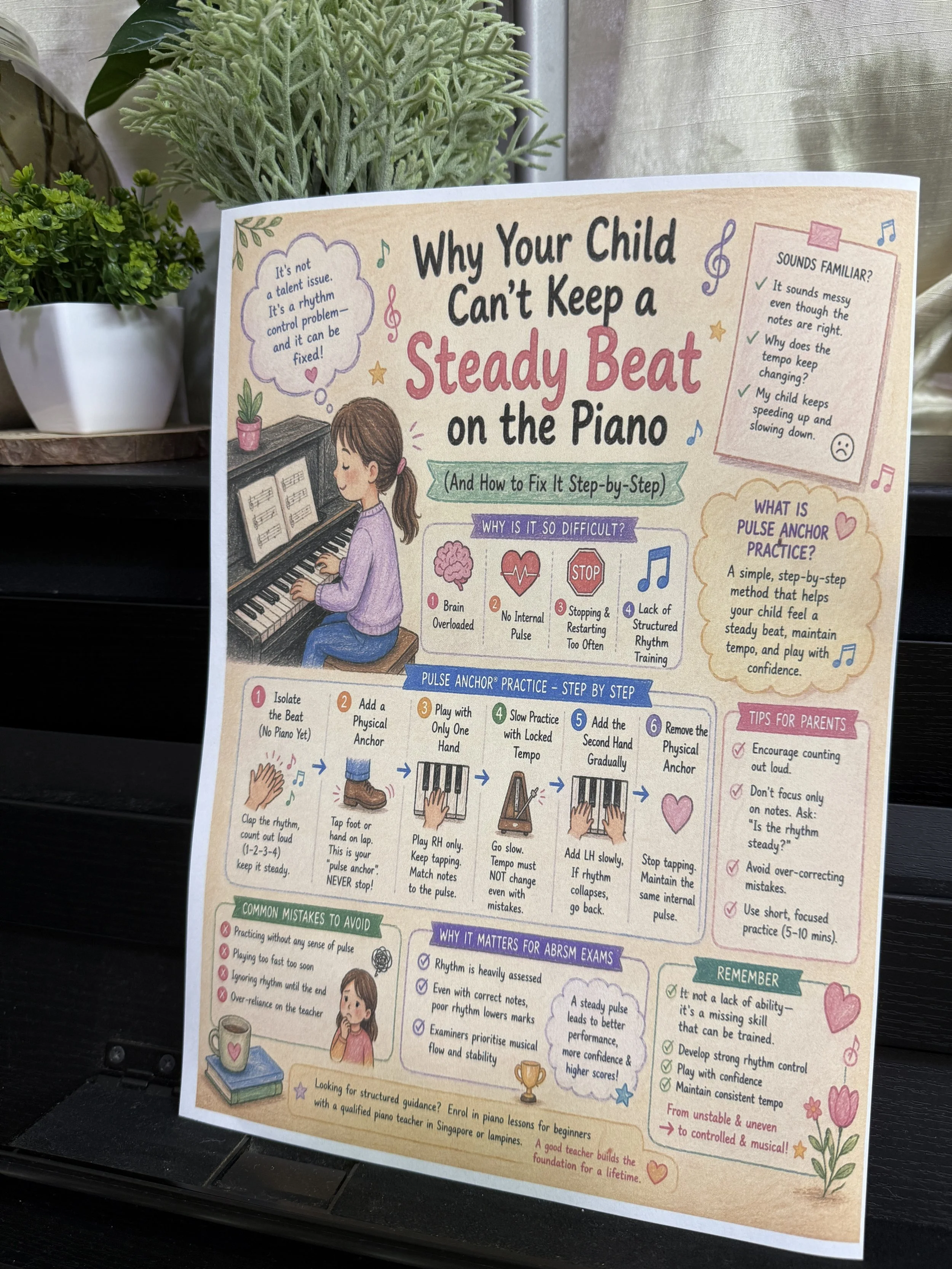
Why Your Child Can’t Keep a Steady Beat on the Piano (And How to Fix It Step-by-Step)

Introduction
Many parents notice this frustrating issue during piano practice:
👉 Their child plays the correct notes…
👉 They recognise the piece…
👉 But the rhythm feels uneven or unstable
You might hear things like:
“It sounds messy even though the notes are right.”
“Why does the tempo keep changing?”
“My child keeps speeding up and slowing down.”
This is one of the most common challenges for students taking piano lessons for beginners, especially in the early stages of learning.
The good news is this:
👉 This is not a talent issue.
👉 It is a rhythm control problem—and it can be fixed with the right approach.
In this article, we will explain why this happens and introduce a practical method called Pulse Anchor Practice, a powerful way to develop steady rhythm and musical confidence.
Why Keeping a Steady Beat Is So Difficult
Before fixing the issue, it is important to understand the root causes.
1. The Brain Is Overloaded
When beginners learn piano, they are trying to manage:
Reading notes
Coordinating both hands
Controlling finger movement
Listening to sound
Because of this, rhythm becomes unstable when attention shifts.
👉 The brain prioritises “playing correct notes”
👉 Rhythm becomes inconsistent as a result
2. No Internal Pulse Is Developed
Many students rely entirely on external cues:
Listening to recordings
Following teacher demonstrations
But they do not develop an internal sense of pulse.
Without this internal timing:
Tempo drifts
Notes get uneven
Music loses structure
3. Stopping and Restarting Too Often
A very common habit:
👉 Play → mistake → stop → restart
This breaks the natural flow of rhythm and prevents the brain from learning continuity.
4. Lack of Structured Rhythm Training
Most students practise:
Notes
Fingering
Sections
But rarely practise rhythm as a separate skill.
What Is Pulse Anchor Practice?
Pulse Anchor Practice is a structured method that trains students to:
👉 Feel a consistent beat internally
👉 Maintain tempo even under difficulty
👉 Stabilise rhythm across the entire piece
Instead of focusing on notes first, this method focuses on building a rhythmic foundation.
Step-by-Step: How to Use Pulse Anchor Practice
Step 1 — Isolate the Beat (No Piano Yet)
Before touching the piano:
Clap the rhythm of the piece
Count out loud (e.g. “1-2-3-4”)
Keep a steady tempo
Goal:
👉 Separate rhythm from notes completely
Step 2 — Add a Physical Anchor
Introduce a consistent body movement:
Tap foot
Tap hand lightly on lap
This becomes your “pulse anchor”
Important:
👉 The tapping must NEVER stop—even if mistakes happen
Step 3 — Play with Only One Hand
Now go to the piano:
Play RH only
Keep the foot tapping steady
Focus on:
👉 Matching notes to the pulse
Do NOT stop if mistakes occur.
Step 4 — Slow Practice with Locked Tempo
Choose a very slow tempo.
Rule:
👉 Tempo must NOT change
Even if:
You hesitate
You make mistakes
The pulse continues.
Step 5 — Add the Second Hand Gradually
Once stable:
Add LH slowly
Keep pulse anchor active
If rhythm collapses:
👉 Go back to one hand
Step 6 — Remove the Physical Anchor
Final stage:
Stop tapping
Maintain the same internal pulse
This is where real rhythm control is developed.
Practical Tips for Parents
If your child is taking piano lessons for beginners, here’s how you can help:
✔ Encourage Counting Out Loud
Even if it sounds simple, it builds strong rhythm foundation.
✔ Don’t Focus Only on Notes
Ask:
👉 “Is the rhythm steady?”
Not just:
👉 “Are the notes correct?”
✔ Avoid Over-Correcting Mistakes
Let your child continue playing instead of restarting constantly.
✔ Use Short, Focused Practice
5–10 minutes of rhythm-focused practice is more effective than long unfocused sessions.
Common Mistakes to Avoid
❌ Practising Without Any Sense of Pulse
This leads to inconsistent tempo habits.
❌ Playing Too Fast Too Soon
Speed hides rhythm problems—it does not solve them.
❌ Ignoring Rhythm Until the End
Rhythm must be trained from the beginning, not “fixed later”.
❌ Over-Reliance on the Teacher
Students must develop their own internal timing, not depend on external guidance.
Why This Matters for ABRSM Exams
In ABRSM piano exams:
Rhythm is heavily assessed
Even with correct notes, poor rhythm lowers marks
Examiners prioritise musical flow and stability
Developing a steady pulse early:
👉 Improves performance
👉 Builds confidence
👉 Increases exam success rates
Conclusion
If your child struggles with keeping a steady beat, remember:
👉 It is not a lack of ability
👉 It is a missing skill that can be trained
By using Pulse Anchor Practice, students can:
Develop strong rhythm control
Play with confidence
Maintain consistent tempo
Over time, this transforms their playing from:
❌ Unstable and uneven
➡️ Into
✅ Controlled and musical
If you are looking for structured guidance, personalised feedback, and proven methods to help your child improve, consider enrolling in piano lessons for beginners with a qualified piano teacher in Singapore or Tampines.
A good teacher will not only correct mistakes—but build the right foundation from the start.
You may also get a printable copy of this blog article. Click on the poster for more details.