Why Your Child Can’t Play Softly on the Piano (And How to Fix Dynamic Control Early)
Introduction
Many parents notice this during piano practice:
👉 Their child can play the correct notes
👉 The rhythm is mostly steady
👉 But everything sounds… loud
Even when the music is supposed to be soft, the sound remains the same.
You might hear comments like:
“Why is everything so loud?”
“Can you play more gently?”
“It sounds a bit harsh.”
This is a very common issue in piano lessons for beginners, especially for young students.
The problem is not just about “playing softer.”
👉 It is about dynamic control — one of the most important musical skills that beginners often lack.
In this article, we will explain why this happens and how to fix it effectively.
What This Topic Means
In piano playing, dynamics refer to how loud or soft the music is played.
Some common terms include:
Piano (p) → soft
Mezzo piano (mp) → moderately soft
Forte (f) → loud
But here’s what many beginners don’t realise:
👉 Playing softly is not just “pressing lightly.”
👉 It requires control, awareness, and technique.
Soft playing involves:
Controlled finger movement
Relaxed hand and arm weight
Listening carefully to sound
Adjusting touch based on musical intention
For beginners, this level of control does not come naturally.
Why It Matters for Piano Students
Dynamic control is not an “advanced” skill.
👉 It is a foundational skill that should be developed from the beginning.
Without it, music can sound:
Flat
Mechanical
Emotionless
For students preparing for ABRSM piano lessons, dynamics are critical because:
Examiners assess musical expression
Marks are awarded for tone and control
Pieces require contrast between soft and loud sections
Even at early grades, students are expected to show:
Basic dynamic contrast
Awareness of musical markings
Ability to shape phrases
Without learning this early, students often struggle later.
Common Problems Students Face
1. Hitting the Keys Instead of Controlling Them
Many beginners “attack” the keys rather than press them with control.
This creates:
Harsh tone
Lack of nuance
Inconsistent sound
2. Lack of Finger Strength and Control
Young students especially may not yet have:
Fine motor control
Finger independence
Sensitivity in touch
As a result, everything comes out at one volume level.
3. Not Listening to Their Own Playing
A very common issue:
👉 Students focus on notes, not sound.
They may not even realise:
They are playing too loudly
There is no contrast in dynamics
4. Misunderstanding “Soft Playing”
Some students think:
❌ Soft = weak
❌ Soft = slow
❌ Soft = hesitant
But in reality:
✅ Soft playing should still be controlled and clear
5. Tension in Hands and Arms
Tension prevents control.
If a student is:
Stiff
Tight
Overusing force
👉 It becomes very difficult to produce soft, controlled sound.
Practical Teaching and Practice Advice
Here are effective, teacher-tested strategies to fix this problem:
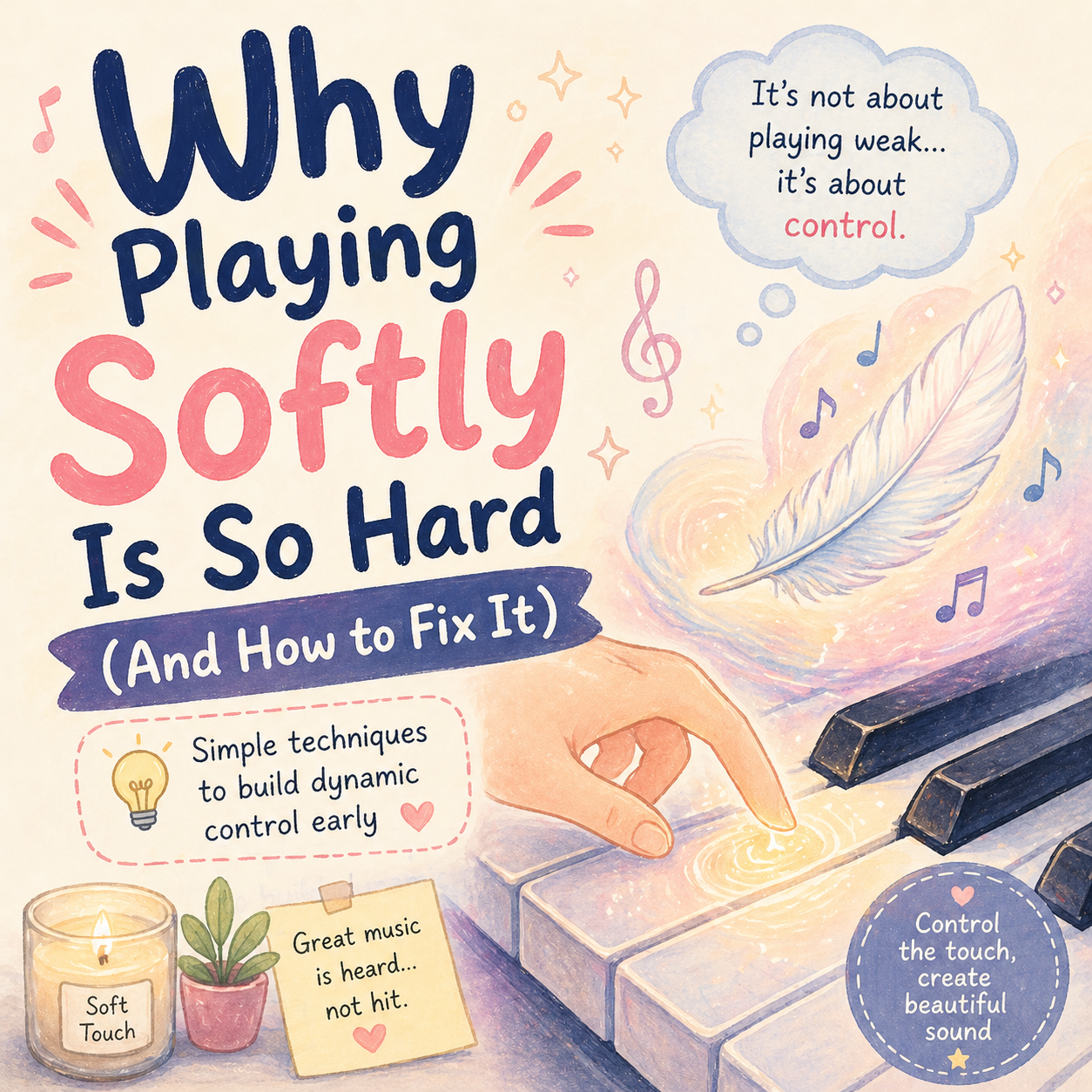
1. The “Feather Touch” Exercise
Ask the student to imagine:
👉 “You are touching something very delicate.”
Then:
Play a single note as softly as possible
Repeat slowly
Listen carefully to the sound
Goal:
👉 Develop awareness of how little pressure is needed
2. Practice with “Dynamic Levels”
Use a simple scale or 5-finger pattern.
Play it in levels:
Very soft
Medium
Loud
Then mix them:
Soft → loud → soft
Loud → soft → medium
This builds dynamic flexibility.
3. Use Storytelling (Very Effective for Children)
Instead of saying “play softly,” say:
“Play like you don’t want to wake a sleeping baby”
“Play like you are sneaking quietly”
Children respond better to imagery than technical instructions.
4. Slow Practice with Listening Focus
Have the student:
Play slowly
Focus ONLY on sound
Ignore speed completely
Ask:
👉 “Was that soft enough?”
👉 “Can you make it even softer?”
This trains active listening.
5. Relaxation Check
Before playing:
Shake out hands
Drop arms loosely
Ensure shoulders are relaxed
Then play softly again.
👉 Relaxation = better control
6. Contrast Practice
Take a simple piece and exaggerate:
Very loud sections → REALLY loud
Soft sections → VERY soft
This helps students understand contrast clearly.
How a Good Piano Teacher Helps
Developing dynamic control is not just about telling a student to “play softer.”
It requires:
Careful guidance
Progressive exercises
Real-time feedback
Proper technical correction
In structured piano lessons in Tampines, a teacher will:
Identify the root cause (technique, tension, or awareness)
Demonstrate correct touch
Guide the student step-by-step
Reinforce listening skills
At Herman Piano Studio, students are taught:
How to control sound from the very beginning
How to connect technique with musical expression
How to develop sensitivity at the keyboard
This ensures that students do not just “play notes,” but learn to make music.
Conclusion
If your child cannot play softly on the piano, it is not a talent issue.
👉 It is a skill that needs to be taught and developed early.
Dynamic control is one of the key differences between:
Playing notes
vsPlaying musically
With the right approach, guidance, and consistent practice:
👉 Every student can learn to control their sound beautifully.
If you are looking for a piano teacher in Singapore, especially for beginner piano lessons in Tampines, choosing a teacher who focuses on sound, control, and musical development from the start can make a significant difference.
At Herman Piano Studio, the goal is not just correct playing—but expressive, confident musicianship from the very first lesson.
