Why Are Italian and German Words Used in Classical Music (Instead of English)?
Introduction
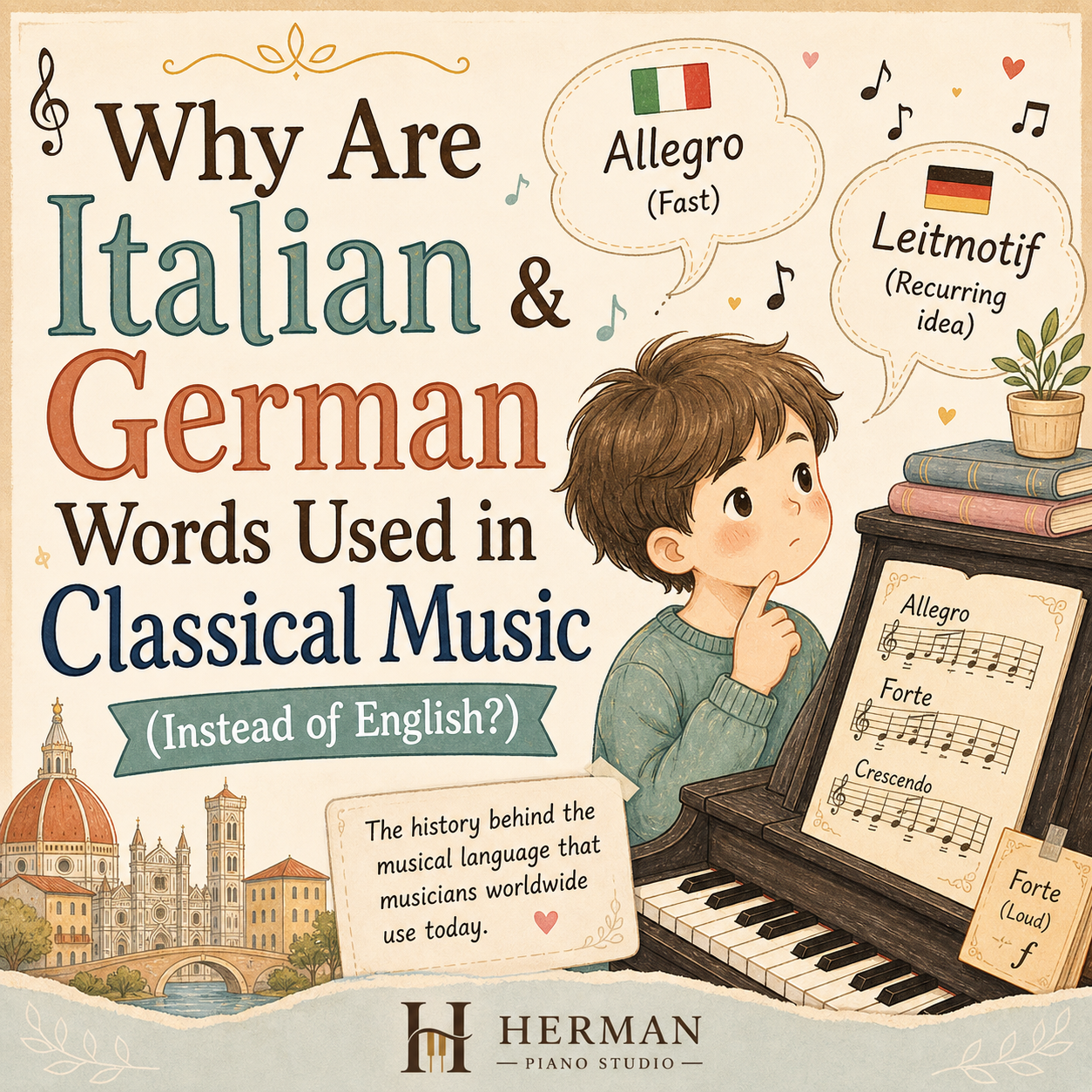
If your child is learning piano, you’ve probably seen words like allegro, forte, or crescendo written all over their music.
Naturally, many parents ask:
👉 “Why isn’t this written in English?”
👉 “Wouldn’t it be easier to just say ‘fast’ or ‘loud’?”
It might seem confusing at first—but there’s actually a fascinating historical reason behind it.
Once you understand it, these terms will start to make a lot more sense.
The Italian Origins of Musical Language
To understand why Italian is everywhere in music, we have to go back to the 1600s.
During this time, Italy was the centre of musical innovation in Europe.
Composers like Claudio Monteverdi were developing opera, and Italian cities became hubs for musicians.
Because of this:
👉 Italian musicians were among the first to write detailed instructions in music scores
They needed a way to tell performers:
How fast to play
How loud or soft to play
What mood to create
So they started using their own language—Italian.
That’s why we still see terms like:
Allegro (fast)
Adagio (slow)
Forte (loud)
Piano (soft)
Over time, these terms became standardised across Europe.
How German (and Others) Entered the Picture
As music spread across Europe, different countries began contributing their own ideas.
In German-speaking regions, composers like Ludwig van Beethoven and Richard Wagner started using German words—especially for expressive and descriptive markings.
For example:
Leitmotif (a recurring musical idea linked to a character or idea)
Mit Ausdruck (with expression)
German terms were often used when composers wanted more detailed or philosophical expression, beyond simple tempo or dynamics.
Later, French composers like Claude Debussy also added French terms, especially for tone colour and style.
A Surprising Insight (Most People Don’t Know This)
Even though composers came from many countries, Italian remained the “default language” of music.
Why?
👉 Because music needed a universal system.
Imagine if every composer used their own language:
A German piece in German
A French piece in French
An English piece in English
It would be confusing for performers around the world.
So instead, musicians kept Italian as a common musical language, much like how English is used globally in aviation today.
Why This Matters for Piano Students
For beginners, these foreign words can feel intimidating.
But here’s the key:
👉 These are not just “fancy words” — they are precise musical instructions
For example:
Allegro doesn’t just mean “fast” — it suggests a bright, lively character
Piano doesn’t just mean “soft” — it implies control and sensitivity
Learning these terms helps students:
Understand music more deeply
Play with better expression
Communicate with musicians worldwide
Conclusion (Simple Takeaway)
Italian words dominate classical music because:
👉 Italy was the birthplace of many early musical traditions
👉 These terms became standard across Europe
👉 Later, German and French added more expressive detail
Today, these languages form a shared musical vocabulary used by musicians everywhere.
So the next time you see allegro or forte in your score—
You’re not just reading instructions.
You’re reading a piece of history.
Note: Article is meant to serve as an introduction to a beginning music student and it is not meant to be a scholarly review. If you are interested to know more, reach out for a piano teacher near tampines today.
📚 References
Encyclopaedia Britannica — History of Western Music Notation and Terminology
ABRSM — Music Theory Resources
Grout, Donald Jay & Palisca, Claude V. — A History of Western Music
Taruskin, Richard — The Oxford History of Western Music
