Why You Keep Making Mistakes on the Piano (Even After Practice) — And How to Fix It
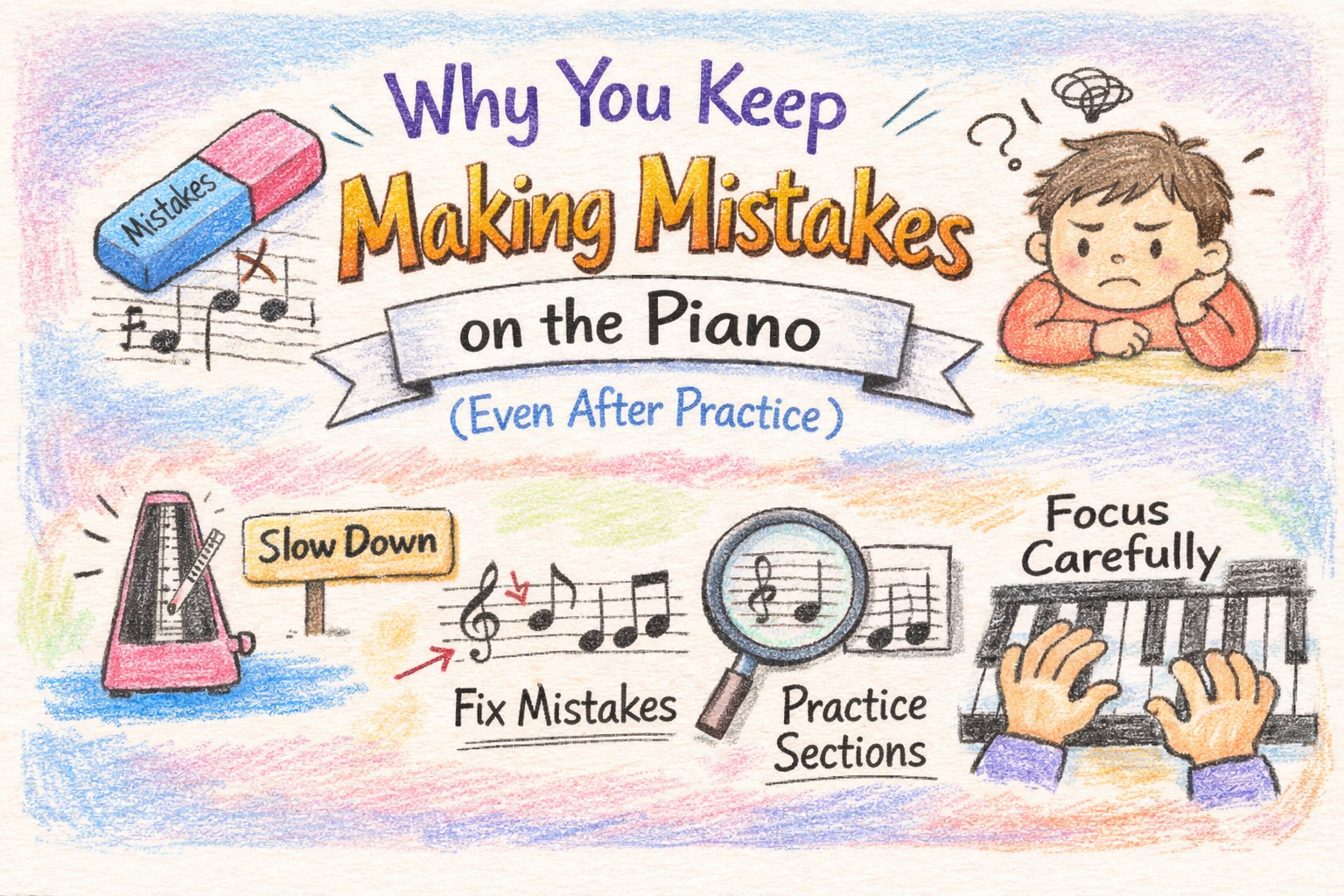
Introduction
Many piano students experience this frustrating situation:
You practise a piece repeatedly, it feels fine during practice… but the next day, the same mistakes come back.
Parents often say:
“My child practises every day, but still plays the same wrong notes.”
Students may feel stuck and wonder:
“Why am I not improving even though I practise?”
This is one of the most common issues I see as a piano teacher in Singapore. The good news is that it is not a lack of ability. It is usually a problem with how you practise, not how much you practise.
In this article, I will explain why this happens and give you clear, practical piano practice tips to fix it effectively.
What Is the Problem (Simple Explanation)
The problem is simple:
👉 You are repeating mistakes during practice, and your brain is learning them as “correct.”
When you practise incorrectly:
Your fingers remember the wrong notes
Your brain reinforces incorrect patterns
Your playing becomes inconsistent
This affects:
Beginner piano students who are still learning coordination
Intermediate students preparing for ABRSM exams
Even adults learning piano for the first time
Why This Problem Happens
1. Playing Too Fast Too Early
Many students try to play at full speed before they are ready.
This leads to:
Sloppy finger movement
Missed notes
Lack of control
2. Not Fixing Mistakes Immediately
A very common habit:
Make a mistake → continue playing → ignore it
This trains the brain to accept mistakes as normal.
3. Practising from the Beginning Every Time
Students often restart from bar 1 repeatedly.
Problem:
Difficult sections are not isolated
Weak areas never improve
4. Lack of Mental Focus
Practising without thinking is one of the biggest issues.
Examples:
Playing while distracted
Letting fingers “run automatically”
Not listening carefully
5. No Clear Practice Strategy
Many students simply “play through” pieces instead of using structured piano practice techniques.
Step-by-Step Practice Solutions
Here’s how to fix this problem effectively.
✅ 1. Slow Practice (Your Most Powerful Tool)
Slow practice is essential if you want to improve piano playing.
How to do it:
Play at 50% of your normal speed
Ensure every note is correct
Keep your fingers controlled and relaxed
👉 If you cannot play it slowly, you cannot play it correctly.
✅ 2. Stop Immediately When You Make a Mistake
This is a rule I teach all my students:
👉 Never practise mistakes.
Instead:
Stop immediately
Identify the error
Replay the correct version 3–5 times
This rewires your muscle memory properly.
✅ 3. Isolate Difficult Sections
Do NOT always start from the beginning.
Instead:
Identify the exact bar where mistakes happen
Practise only that section
Example:
Bars 8–10 are difficult → practise only those bars repeatedly
This is one of the most effective piano practice tips.
✅ 4. Hands Separate Practice
If coordination is the issue:
Practise right hand alone
Practise left hand alone
Then combine slowly
This builds accuracy and confidence.
✅ 5. Use Rhythmic Variations
For fast or tricky passages:
Try:
Long-short rhythm
Short-long rhythm
This improves:
Finger control
Evenness
Accuracy
✅ 6. Practise with Full Attention
Quality matters more than quantity.
Ask yourself while practising:
“Did I play that correctly?”
“Was that even?”
“Did I hear the mistake?”
👉 Focused 15 minutes is better than distracted 45 minutes.
Practical Practice Routine
Here is a simple daily routine students can follow:
🎯 15–30 Minute Practice Plan
1. Warm-up (3–5 mins)
Scales or simple exercises
2. Problem Section Work (10–15 mins)
Identify 1–2 difficult sections
Practise slowly
Fix mistakes immediately
3. Hands Separate (5–10 mins)
Focus on coordination
4. Play Through (5 mins)
Play the full piece slowly and carefully
Common Mistakes to Avoid
❌ Playing from start to finish repeatedly
❌ Ignoring mistakes
❌ Practising too fast
❌ Relying only on repetition
❌ Practising without listening
Conclusion
If you feel stuck in your piano progress, remember this:
👉 Improvement does not come from playing more — it comes from practising correctly.
By using the right piano practice techniques:
Slowing down
Fixing mistakes immediately
Focusing on problem areas
You will see real progress.
If you or your child need structured guidance, working with an experienced piano teacher in Singapore can make a big difference in building strong, effective practice habits.
You can download my free practice guide here.
