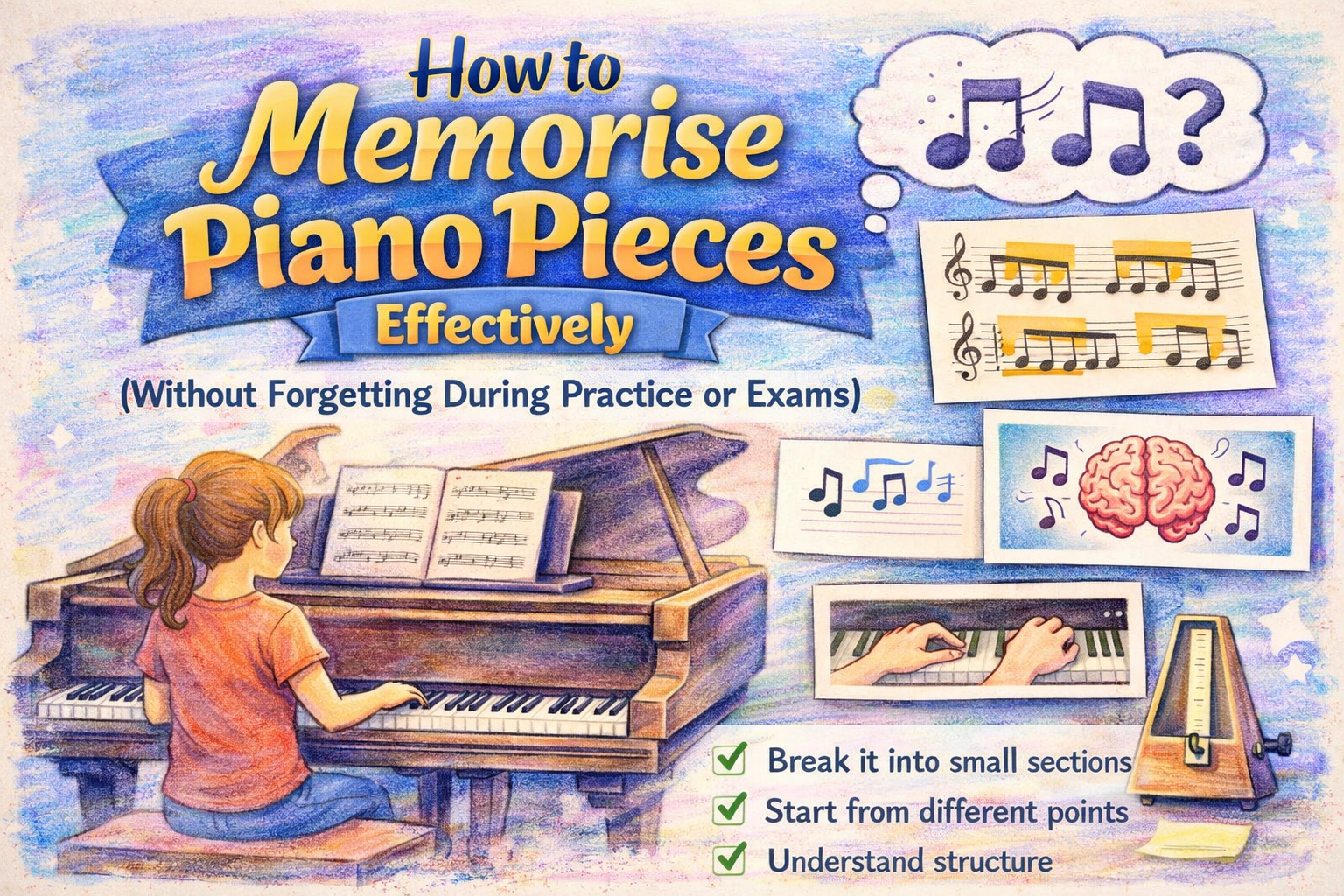
How to Memorise Piano Pieces Effectively (Without Forgetting During Practice or Exams)
Introduction
Many piano students face a frustrating problem:
You practise a piece for weeks, memorise it well… and then suddenly—you forget everything halfway through.
This is especially stressful for students preparing for performances or exams.
Parents often notice their child can play confidently at home, but during lessons or exams, the memory seems to “blank out.”
The truth is, memorising piano music is not just about repetition. It requires a clear strategy and understanding of how memory works.
In this article, we will explore why students forget pieces and share practical, proven piano practice tips on how to memorise music effectively—especially for those taking piano lessons for beginners or preparing for exams.
Why Memorising Piano Music Can Be Difficult
Before learning how to memorise effectively, it is important to understand why memory slips happen.
1. Relying Only on Muscle Memory
Many students memorise pieces by repeating them over and over.
This creates muscle memory, but without deeper understanding.
The problem?
If something goes wrong (e.g. a small mistake), the student may not know how to recover.
2. Lack of Musical Understanding
Students who do not understand the structure of the music tend to memorise note by note.
This makes memory fragile.
Understanding patterns, chords, and phrases helps create stronger memory.
3. Always Starting From the Beginning
Practising only from the start of the piece means:
The beginning becomes very strong
The middle and ending remain weak
This leads to breakdowns later in the piece.
4. Performance Pressure
During exams or performances, nervousness can affect memory.
Without strong mental preparation, even well-prepared students may experience memory slips.
Types of Memory in Piano Playing
Strong memorisation comes from combining different types of memory.
1. Muscle Memory
Developed through repetition. Helps fingers remember movement.
2. Visual Memory
Remembering how the music looks on the page.
3. Aural Memory
Remembering how the music sounds.
4. Analytical Memory
Understanding structure, chords, and patterns.
Students who combine all four types of memory are far less likely to forget.
How to Memorise Piano Pieces Effectively
1. Break the Piece Into Sections
Instead of memorising the whole piece at once:
Divide it into small sections (2–4 bars)
Memorise each section separately
Connect them gradually
This builds stronger and more reliable memory.
2. Practise Starting From Different Points
Train your memory by:
Starting from the middle
Starting from the ending
Jumping between sections
This prevents reliance on “beginning-only” memory.
3. Understand the Music
Ask yourself:
What key is this in?
What chords are being used?
Are there repeating patterns?
Understanding the structure makes memorisation much easier.
4. Practise Hands Separately
Practising each hand individually helps:
Strengthen memory
Improve accuracy
Build confidence
Once secure, combine both hands.
5. Use Slow Practice
Slow practice allows you to:
Think ahead
Observe patterns
Avoid mistakes
This creates cleaner and more reliable memory.
6. Test Yourself Regularly
Instead of always playing through:
Stop and recall the next notes
Play without looking at the score
Mentally visualise the music
Testing strengthens memory more than repetition alone.
7. Practise Away From the Piano
Advanced students often practise mentally.
Try:
Visualising the keyboard
Imagining the sound
“Playing” the piece in your head
This strengthens mental memory and prepares students for performance situations.
Practical Piano Practice Tips for Memorisation
Here are simple strategies students can apply immediately.
1. Memorise Early
Do not wait until the piece is fully learned. Start memorising small sections early.
2. Use a “Chain Method”
Memorise section A, then A+B, then A+B+C.
3. Play Slowly Without Score
Once memorised, practise slowly without looking at the music.
4. Record Yourself
Listening back helps identify weak memory spots.
5. Simulate Performance
Play the piece without stopping, as if in an exam.
Common Mistakes When Memorising Piano Music
Relying Only on Repetition
This creates weak memory that breaks easily under pressure.
Avoiding Difficult Sections
Students often memorise easy parts first and avoid harder sections.
This creates imbalance in memory strength.
Not Testing Memory
If students always play with the score, memory is never fully developed.
Panicking After a Mistake
Students should learn to recover and continue, rather than stopping completely.
Conclusion
Memorising piano music is a skill that can be developed with the right approach.
Instead of relying only on repetition, students should focus on:
Understanding the music
Practising in sections
Using different types of memory
Testing memory regularly
For students taking beginner piano lessons, learning how to memorise effectively is a valuable skill that will benefit them throughout their musical journey.
With consistent practice and guidance from an experienced piano teacher in Singapore, students can build strong, reliable memory and perform with confidence.
Over time, memorisation becomes not a source of stress—but a powerful tool for expressive and confident piano playing.
