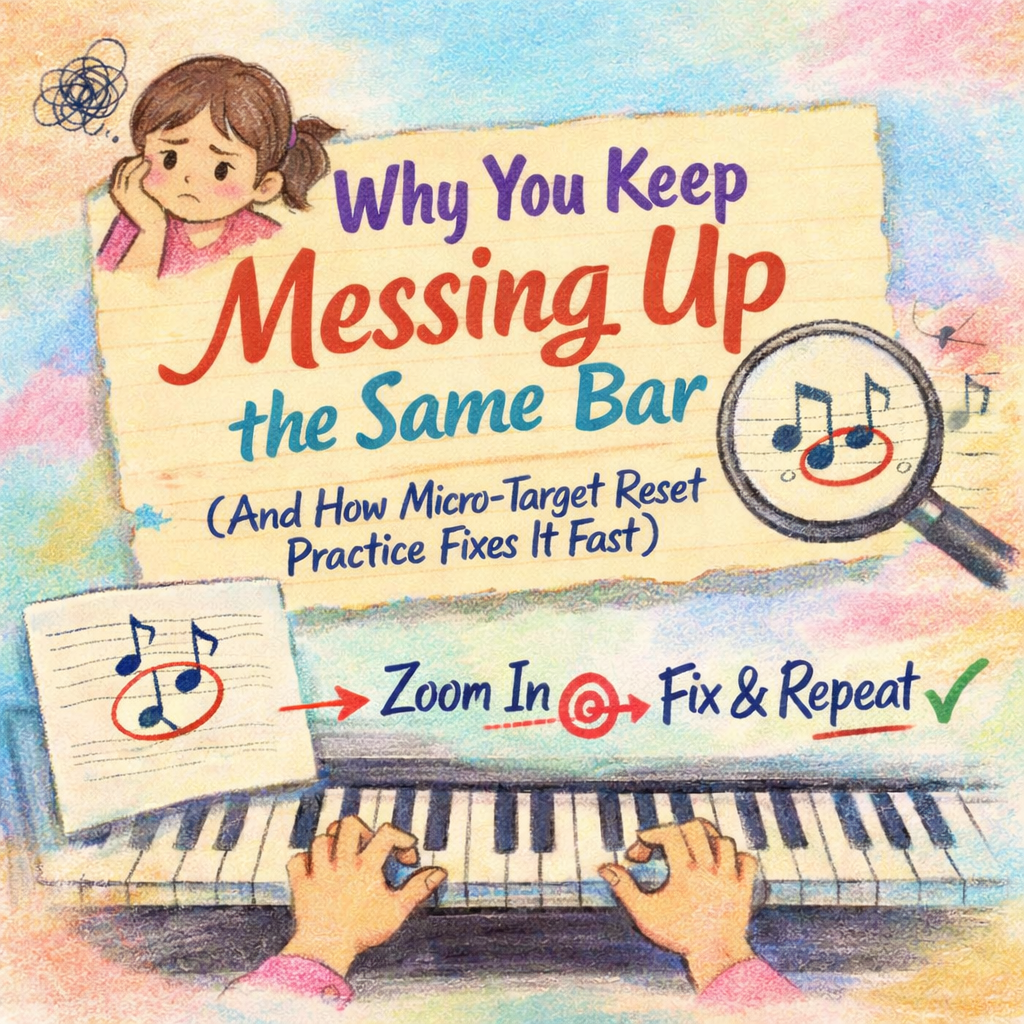
Why You Keep Messing Up the Same Bar (And How “Micro-Target Reset Practice” Fixes It Fast)
Introduction
Have you ever experienced this during piano practice?
You play through your piece… and everything goes well—until that one bar.
👉 You stumble.
👉 You restart.
👉 You try again… and make the same mistake.
Parents often say:
“My child keeps repeating the same mistake no matter how much they practise.”
Students feel frustrated:
“I’ve played this section so many times—why is it still not improving?”
This is one of the most common problems faced by students taking piano lessons for beginners, as well as intermediate students preparing for exams.
The issue is not lack of effort.
It’s that the practice method is not targeting the problem effectively.
In this article, we’ll explore why this happens—and introduce a powerful technique called Micro-Target Reset Practice that can fix stubborn mistakes quickly and efficiently.
What Is the Problem (Simple Explanation)
The problem is simple:
👉 You are practising too broadly instead of specifically.
Most students:
Play from the beginning of the piece
Repeat large sections
Hope the difficult bar will “fix itself”
But here’s what actually happens:
The brain reinforces mistakes through repetition
The difficult spot never gets isolated properly
Frustration builds because progress feels slow
In short:
👉 You are practising around the problem—not on the problem.
Introduce the Practice Technique (Main Concept)
🎯 Micro-Target Reset Practice
Micro-Target Reset Practice is a focused method where you:
👉 Isolate the exact smallest unit of the mistake
👉 Reset it deliberately
👉 Rebuild it correctly with full control
Instead of practising a whole phrase or line, you zoom in to:
1–2 beats
Even just 2–3 notes if needed
Why It Works
This technique works because:
The brain learns best in small, accurate chunks
Mistakes are easier to correct when isolated
You eliminate “error memory” and replace it with correct patterns
Think of it like fixing a typo in a sentence:
You don’t rewrite the whole paragraph—you correct the exact word.
Step-by-Step: How to Use This Technique
Let’s say you keep making a mistake in bar 12 of your piece.
Step 1: Identify the Exact Problem Spot
Don’t say “bar 12 is hard.”
Instead, pinpoint it:
👉 “The problem is between beat 3 and 4”
👉 “The left hand jump is inaccurate”
Be specific.
Step 2: Shrink the Target
Reduce the section to the smallest unit:
Only the problematic notes
Possibly just 2–4 notes
Example:
Instead of practising the full bar, play only:
👉 Last 2 notes of beat 3 → first note of beat 4
Step 3: Stop and Reset
Before repeating:
Pause
Relax your hands
Mentally prepare the correct movement
This is the reset.
Avoid mindless repetition.
Step 4: Play It Correctly (Slow but Intentional)
Now play the micro-section:
With full attention
Clean and controlled
No rushing
If incorrect → stop immediately and reset again.
Step 5: Repeat in Controlled Cycles
Repeat 5–8 times:
Only if correct
Always resetting between attempts
👉 Quality over quantity
Step 6: Expand Gradually
Once stable:
Add 1–2 notes before
Add 1–2 notes after
Slowly rebuild the full passage.
Step 7: Reintegrate Into Context
Finally:
Play the full bar
Then the full phrase
Check if the problem is gone.
When Should You Use This Technique
Micro-Target Reset Practice is especially useful when:
1. You Keep Repeating the Same Mistake
Wrong notes
Uneven rhythm
Inaccurate jumps
2. A Section Feels “Unreliable”
Works sometimes, fails sometimes
Not consistent under pressure
3. Preparing for ABRSM Exams
Where precision matters
Small errors affect marks
4. Suitable Levels
✔ Beginner piano lessons
✔ Intermediate students
✔ Advanced students polishing repertoire
This is a universal technique for anyone learning how to learn piano effectively.
Benefits of This Technique
✅ 1. Faster Improvement
You stop wasting time on sections that are already correct and focus only on what needs fixing.
✅ 2. Better Accuracy
By isolating the problem, your brain builds clean and reliable movement patterns.
✅ 3. Increased Confidence
When a difficult bar becomes secure, the entire piece feels easier.
✅ 4. Reduced Frustration
No more endless repetition with no progress.
Practice becomes:
👉 Clear
👉 Structured
👉 Effective
✅ 5. Stronger Memory and Control
You are no longer relying on guesswork or muscle memory alone.
Instead, you build:
Awareness
Control
Intentional playing
Common Mistakes to Avoid
❌ 1. Not Shrinking Enough
Many students still practise too much at once.
👉 If it’s still difficult, make it smaller.
❌ 2. Skipping the Reset
Repeating without pausing leads to:
Reinforcing mistakes
Mental fatigue
Always reset before each attempt.
❌ 3. Rushing the Process
Students often try to:
Expand too quickly
Return to full tempo too soon
Build slowly → then speed up.
❌ 4. Ignoring the Cause
Sometimes the issue is:
Fingering
Hand position
Lack of preparation
Fix the root, not just the symptom.
Conclusion
If you find yourself stuck on the same bar again and again, remember this:
👉 The problem is not how much you practise
👉 It’s how you practise
Micro-Target Reset Practice teaches you to:
Focus precisely
Correct efficiently
Build confidence step by step
For students and parents looking for piano lessons for beginners or more structured guidance, learning the right practice method early makes a huge difference.
At Herman Piano Studio, we focus not just on playing pieces—but on teaching students how to learn piano effectivelywith proven strategies like this.
If you’re looking for a dedicated piano teacher Singapore or specifically a piano teacher Tampines, structured and intelligent practice methods like these are what truly accelerate progress.
