Why Your Playing Falls Apart at Speed (And How “Tempo Layer Bridging” Builds Control That Actually Lasts)
Introduction
Have you ever experienced this?
You practise your piece slowly… everything sounds clean and controlled.
But the moment you try to play at full speed:
👉 Notes become uneven
👉 Fingers panic
👉 Mistakes suddenly appear
Students often say:
“I can play it perfectly slowly, but I can’t play it fast.”
Parents notice:
“My child practises carefully, but during exams or performances, everything falls apart.”
This is one of the most frustrating problems for students in piano lessons for beginners, as well as intermediate players preparing for exams.
It feels like progress is happening—but somehow it doesn’t translate into real performance.
The issue is not effort.
It’s a missing step in the practice process.
In this article, you’ll learn a powerful technique called Tempo Layer Bridging—a method that helps you transition from slow practice to full speed without losing control.
What Is the Problem (Simple Explanation)
The core problem is this:
👉 Students treat slow practice and fast playing as two separate skills.
What typically happens:
You practise slowly (e.g. 60 bpm)
Then suddenly jump to full speed (e.g. 120 bpm)
This creates a gap.
Your brain and muscles:
Learn control at slow speed
But panic when speed increases
Why?
Because:
Finger coordination changes at higher speeds
Movements must become more efficient
Timing becomes more precise
In short:
👉 You never trained the “in-between speeds”
Introduce the Practice Technique (Main Concept)
🎯 Tempo Layer Bridging
Tempo Layer Bridging is a structured method where you:
👉 Gradually train multiple “tempo layers”
👉 Build control at each level
👉 Smoothly bridge from slow to fast playing
Instead of jumping from slow to fast, you create stepping stones between tempos.
Why It Works
This technique works because:
The brain adapts progressively to increasing demands
Finger movements become efficient step-by-step
You eliminate the shock of sudden tempo changes
Think of it like climbing stairs:
You don’t jump from the ground to the second floor—you take one step at a time.
Step-by-Step: How to Use This Technique
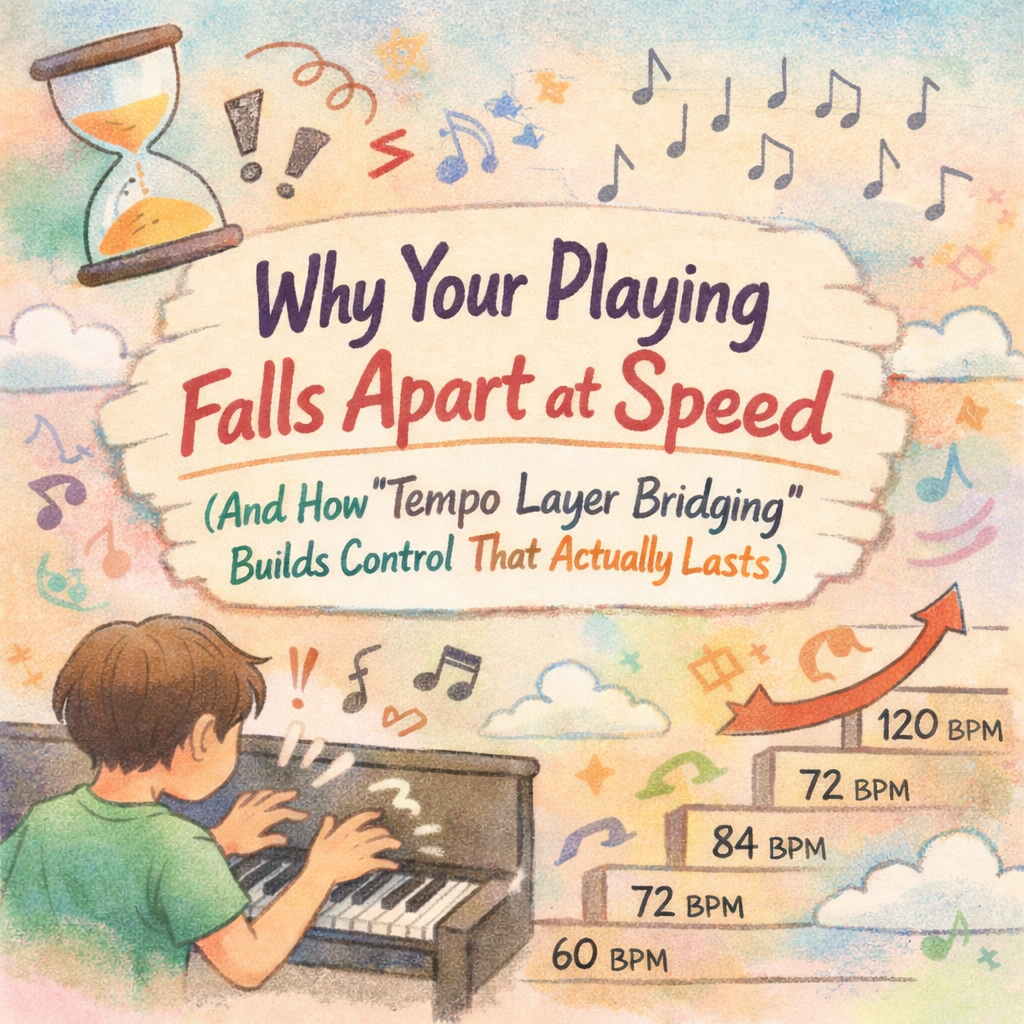
Let’s say your target tempo is 120 bpm, but you can only play cleanly at 60 bpm.
Step 1: Define Your Tempo Layers
Break the tempo into stages:
60 bpm (comfortable)
72 bpm
84 bpm
96 bpm
108 bpm
120 bpm (target)
Each step is a bridge layer.
Step 2: Stabilise the First Layer
Start at your comfortable tempo:
👉 Play with full control
👉 Ensure accuracy and relaxation
Do NOT move on until it feels easy.
Step 3: Move Up One Layer Only
Increase slightly (e.g. +10–15 bpm):
👉 Focus on maintaining the same control
👉 Notice any tension or mistakes
If it breaks:
👉 Go back down, fix it, then try again
Step 4: Lock Each Layer
At every tempo:
Repeat until consistent
Aim for 3–5 clean repetitions
This “locks in” control at that speed.
Step 5: Observe Changes in Movement
As tempo increases, notice:
Smaller finger movements
Less lifting
More efficient hand positioning
👉 Let your technique adapt naturally
Step 6: Bridge the Difficult Layers
Some tempos will feel harder than others.
For example:
84 → 96 bpm may feel unstable
Spend extra time here.
👉 These are your “weak bridges”
Step 7: Reach Full Tempo Gradually
By the time you reach 120 bpm:
👉 Your fingers are already prepared
👉 Your brain has adapted step-by-step
No sudden shock. No panic.
When Should You Use This Technique
Tempo Layer Bridging is especially useful when:
1. Pieces Fall Apart at Full Speed
Clean slowly, messy fast
Lack of control under pressure
2. Preparing for Exams (ABRSM)
Consistency is critical
Examiners expect stable tempo
3. Fast Passages or Technical Sections
Scales, runs, arpeggios
Repeated patterns
4. Suitable Levels
✔ Beginner piano lessons
✔ Intermediate students
✔ Advanced students refining performance
This is a core method for anyone serious about how to learn piano efficiently.
Benefits of This Technique
✅ 1. Reliable Speed Control
You don’t just “hope” to play fast—you build up to it systematically.
✅ 2. Better Accuracy at High Speed
Because each tempo is trained:
👉 Fewer mistakes at full speed
✅ 3. Reduced Performance Anxiety
Your playing feels secure because:
👉 You’ve already mastered every stage
✅ 4. Faster Long-Term Progress
Although it feels slower at first:
👉 You waste less time fixing mistakes later
✅ 5. Stronger Technical Foundation
You develop:
Efficient movement
Better coordination
Greater control
Common Mistakes to Avoid
❌ 1. Jumping Tempos Too Quickly
Going from 60 → 100 bpm defeats the purpose.
👉 Keep increments small.
❌ 2. Ignoring Unstable Layers
If one tempo feels messy:
👉 Don’t skip it
That’s exactly where improvement is needed.
❌ 3. Forcing Speed
Trying to “push through” tension leads to:
Mistakes
Injury risk
Bad habits
❌ 4. Practising Mindlessly
Each layer requires:
👉 Awareness
👉 Listening
👉 Control
Conclusion
If your playing collapses when you try to go faster, remember:
👉 Speed is not something you force
👉 It is something you build
Tempo Layer Bridging gives you a clear, structured way to:
Transition from slow to fast
Maintain control at every stage
Build confidence in your playing
For students taking piano lessons for beginners, or those preparing for exams, learning the right practice strategy makes all the difference.
At Herman Piano Studio, we focus on teaching students not just what to practise—but how to practise effectively.
If you’re looking for a dedicated piano teacher Singapore or a structured piano teacher Tampines, developing strong practice methods like this is the key to long-term success.
