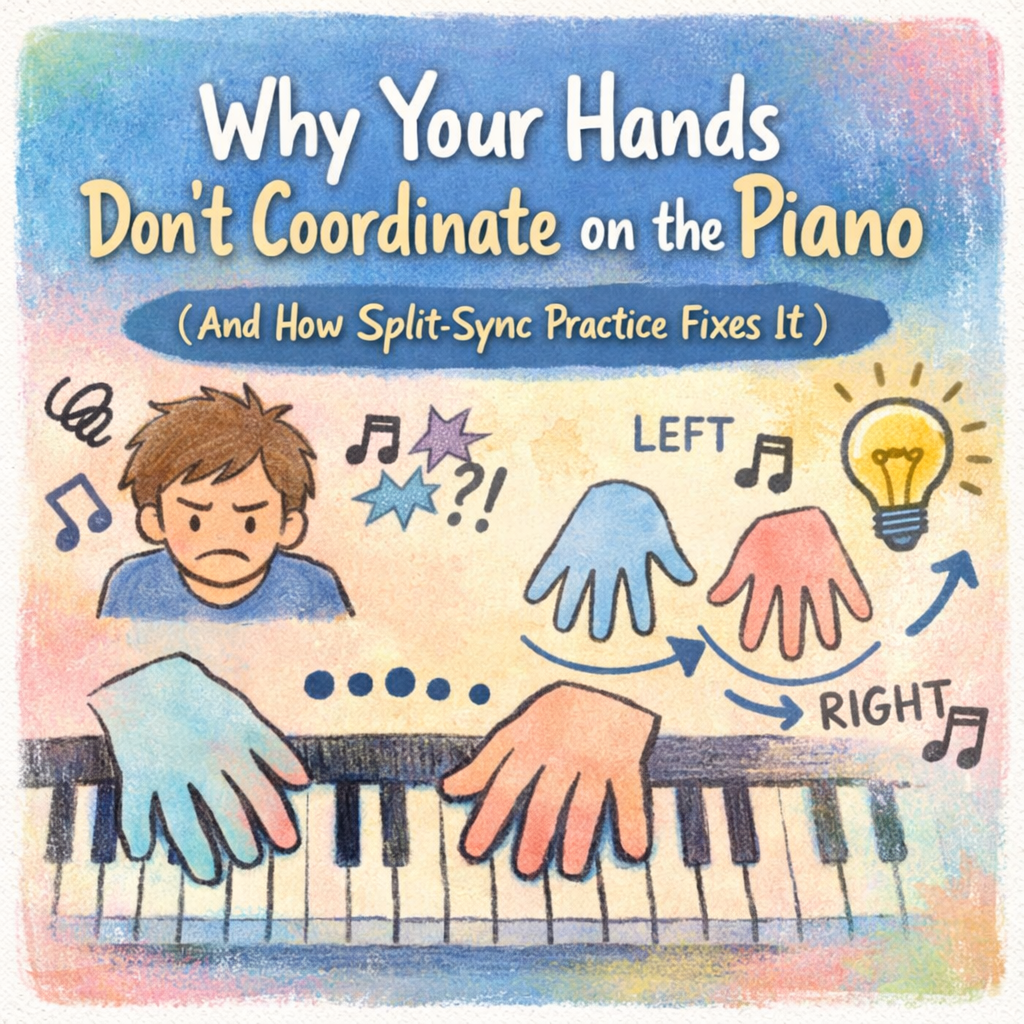
Why Your Hands Don’t Coordinate on the Piano (And How “Split-Sync Practice” Fixes It)
Introduction
Many piano students experience this frustrating problem:
Right hand alone? Fine.
Left hand alone? Also fine.
Both hands together? Everything falls apart.
Notes clash, rhythm becomes uneven, and the piece suddenly feels much harder than expected.
This is one of the most common struggles for students taking piano lessons for beginners, as well as those preparing for exams.
The issue is not talent or intelligence—it is a coordination problem that requires a specific training approach.
In this article, we will introduce a powerful and practical method called Split-Sync Practice, a structured way to build hand coordination step by step.
Why Hands Coordination Is So Difficult
Before fixing the problem, it is important to understand why it happens.
1. The Brain Is Processing Two Different Tasks
Each hand often plays:
Different rhythms
Different notes
Different movements
This requires the brain to manage two independent streams of information at once.
For beginners learning how to learn piano, this can feel overwhelming.
2. One Hand Is Usually Weaker
Most students have:
A stronger dominant hand
A weaker non-dominant hand
When combined, the weaker hand struggles to keep up, causing uneven playing.
3. Practising Hands Separately Is Not Enough
While hands-separate practice is useful, many students:
Practise hands separately
Then immediately try full coordination
This jump is often too big.
4. Lack of Rhythm Alignment
Even if notes are correct, poor rhythmic alignment causes:
Notes to clash
Timing to feel unstable
Loss of musical flow
What Is Split-Sync Practice?
Split-Sync Practice is a step-by-step coordination method that bridges the gap between:
👉 Hands separately → Hands together
Instead of jumping straight into full coordination, students build coordination in controlled layers.
How Split-Sync Practice Works
Step 1: Identify “Sync Points”
Look for where both hands play at the same time.
These are your anchor points.
For example:
First note of each bar
Chord alignments
Strong beats
Step 2: Practise Only the Sync Points
Play only the notes where both hands align.
Ignore the notes in between.
This helps your brain understand:
👉 Where the hands must meet
Step 3: Add One Hand Fully
Next:
Play one hand fully
Add only the sync notes from the other hand
This simplifies coordination while maintaining structure.
Step 4: Fill in the Gaps Gradually
Slowly add more notes between sync points.
Build coordination layer by layer.
Step 5: Play Slowly With Full Coordination
Once the structure is clear:
Play both hands together slowly
Maintain control and accuracy
Why Split-Sync Practice Works
This method works because it:
Reduces cognitive overload
Builds coordination progressively
Strengthens rhythmic alignment
Prevents frustration
It is one of the most effective piano practice tips for students struggling with coordination.
Practical Tips for Better Coordination
1. Slow Down More Than You Think
If coordination feels difficult, you are likely playing too fast.
Slow practice allows your brain to process both hands clearly.
2. Count Aloud
Counting helps align rhythm between hands.
Example:
“1 and 2 and 3 and 4”
3. Use Small Sections
Work on 1–2 bars at a time.
Avoid trying to coordinate the entire piece at once.
4. Practise Daily
Coordination improves with consistent repetition over time.
Short daily practice sessions are more effective than long, infrequent ones.
5. Stay Relaxed
Tension makes coordination harder.
Keep hands relaxed and movements natural.
Common Mistakes Students Make
Jumping Straight to Hands Together
Skipping intermediate steps leads to frustration and mistakes.
Practising Too Fast
Speed hides coordination problems instead of fixing them.
Ignoring Rhythm
Focusing only on notes without rhythm causes misalignment.
Repeating Mistakes
Incorrect repetition reinforces poor coordination.
Who Benefits Most From This Method?
Split-Sync Practice is especially useful for:
Students in beginner piano lessons
Children struggling with coordination
Students preparing for exams
Anyone learning more complex pieces
A skilled piano teacher Tampines will often guide students through similar step-by-step coordination strategies.
Conclusion
Hand coordination is one of the biggest challenges in learning piano—but it is completely trainable.
Instead of struggling with full hands-together playing, students should use structured methods like Split-Sync Practiceto build coordination gradually.
By focusing on:
Sync points
Slow practice
Step-by-step layering
students can transform confusion into clarity.
For those taking piano lessons for beginners, developing coordination early makes learning smoother and more enjoyable.
With guidance from an experienced piano teacher Tampines, students can overcome coordination challenges and play with confidence and control.
